

On November 7, 2025, Deputy Director Chelsea Coffin testified before the DC Council Committee of the Whole at the Academic Achievement Hearing. Her testimony focuses on D.C.’s academic recovery compared to other states and districts, D.C.’s academic progress since the pandemic, and key grades D.C. must focus on to improve academic outcomes. Read the complete testimony below or download the PDF version.
D.C. has had a stronger recovery from the pandemic in recent years, compared to other states and districts as of school year 2023-24. Using the recent results from the 2024 National Assessment of Educational Progress (NAEP) and our own state test (PARCC), the Education Recovery Scorecard from Harvard’s Center for Education Policy Research1 found that D.C. posted the highest gains in math and reading from 2022 to 2024, when compared to other states. This progress didn’t happen by accident—it’s the result of strategic investments and initiatives reflecting best practices in literacy and math supplemented by high-impact tutoring.
In school year 2024-25, the District continued this progress with the largest improvement in statewide assessments since before the pandemic. In English Language Arts (ELA), 38 percent of students met or exceeded expectations. This is a 4-percentage point increase from the previous school year and the highest level of achievement in the last decade. In math, 26 percent of students met or exceeded expectations, a 4-percentage point increase from the previous year.2
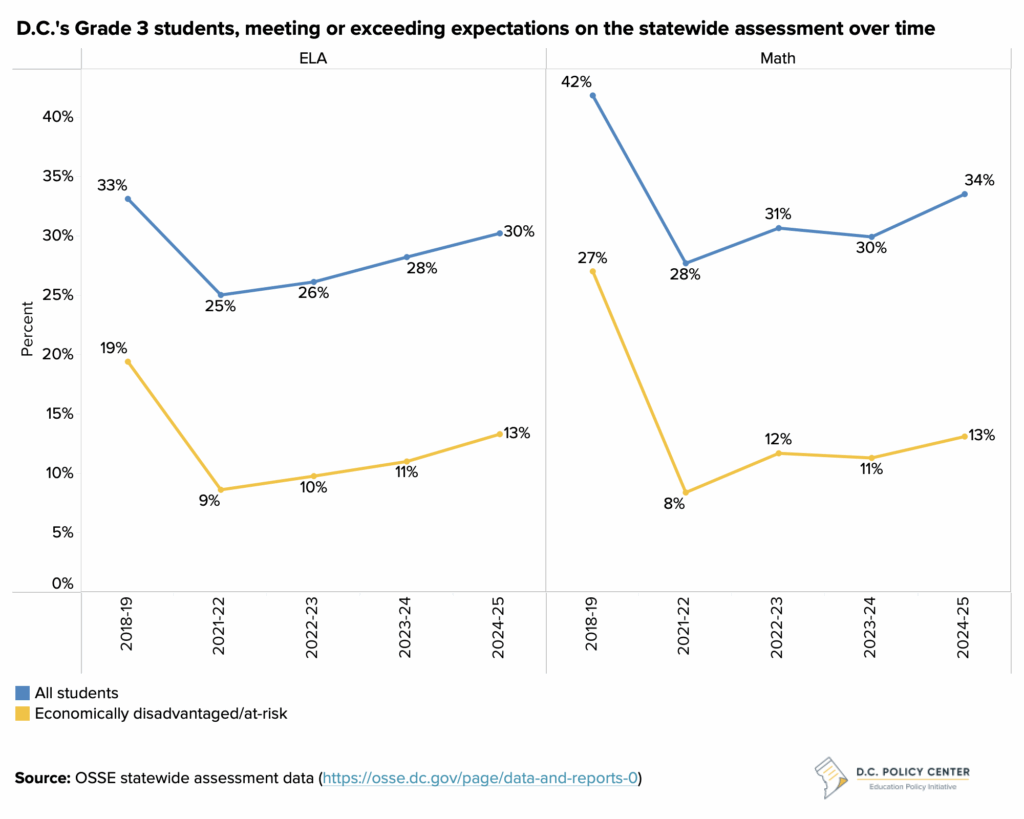
Still, we have a long way to go to ensure academic success for all students in D.C. Grade 3 results on the statewide assessment show that the pandemic’s impact lingers, especially for economically disadvantaged students. These youngest assessed learners, who were likely in pre-kindergarten (PK3) in the spring of 2020 and learned virtually for their second pre-kindergarten year (PK4), are still behind the pre-pandemic cohort. In school year 2024-25, the share of grade 3 students meeting or exceeding expectations in ELA was 3 percentage points lower than their pre-pandemic peers (with a gap twice as large for economically disadvantaged students); and 8 percentage points lower in math (with a gap one and a half times as large for economically disadvantaged students).
In sum, the pandemic’s impacts linger for even those who went through it during the earliest grades. To sustain academic gains, we should double down on proven strategies. We have demonstrated examples: EmpowerK12’s Bold Schools rely on data-driven continuous improvement; deliberate teacher support and professional development; strong school-community relationships; targeted interventions and small group instruction; and a culture of joy, belonging, and student ownership.3
Continuing to invest in academic gains will provide a strong foundation for future learning, which can be part of a virtuous cycle: Academic achievement in the previous year can be a predictor of future attendance.4 This means that higher achievement itself can lead to more attendance, which in turn means more learning time and better learning outcomes.5 I urge the Council to prioritize stable funding for evidence-based interventions, both to sustain achievement gains and to boost attendance.
Endnotes
- Kane, T. and Reardon, S. 2025. Education Recovery Scorecard: District of Columbia. Center for Education Policy Research. Retrieved from https://educationrecoveryscorecard.org/
- Office of the State Superintendent of Education (OSSE). 2025. “2024-25 Statewide Assessment Results and Resources.” OSSE. Retrieved from https://osse.dc.gov/node/1794106
- EmpowerK12. 2025. DC’s 2025 Bold Performing Schools. EmpowerK12. Retrieved from https://www.empowerk12.org/research-source/2025-bold-performance-report
- Coffin, C. and Mason, H. 2025. Patterns and predictors of chronic absenteeism in D.C.’s middle and high schools. D.C. Policy Center. Retrieved from https://www.dcpolicycenter.org/publications/patterns-and-predictors-chronic-absenteeism-dc-middle-and-high-schools/
- Office of the State Superintendent of Education (OSSE). 2024. District of Columbia Attendance Report: School Year 2023-24. OSSE. Retrieved from https://osse.dc.gov/node/1720676