
This publication was co-authored by Armoni Evans, who just completed a summer internship at the D.C. Policy Center through Mikva Challenge supported by the Marion Barry Summer Youth Employment Program.
Every student deserves access to a high-quality public high school education, but what defines “quality” and who has access to it remain important questions across Washington, D.C. Quality is often measured through indicators such as graduation rates, college enrollment, Advanced Placement performance—but it also means the diversity of course offerings and specialized or advanced coursework. Together, these provide a broader understanding of the student experience and how prepared alumni are for life after graduation.
High school student outcomes
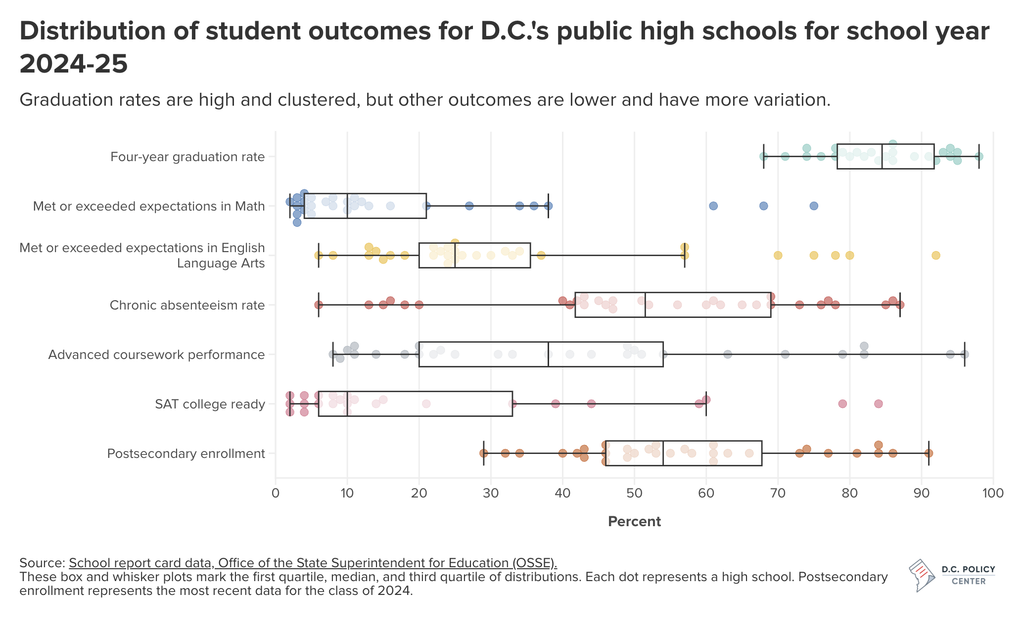
Looking at metrics across D.C.’s public high schools (see chart below), graduation is relatively strong: Four-year graduation rates cluster around 80 to 90 percent, while postsecondary enrollment is generally around 45 to 70 percent. This suggest that many schools are successfully supporting students through graduation and some into further education. However, academic outcomes as measured by the statewide assessment vary substantially across schools. The distributions for math and English Language Arts proficiency are much wider than for high school graduation, with many schools reporting relatively low proficiency rates and a smaller number of schools performing considerably higher.
Course offerings
Across the District, students have multiple public high school options, including DCPS neighborhood schools, selective application schools, and public charter schools. These schools offer a range of pathways, including advanced coursework, Career and Technical Education (CTE), internships, and work-based learning opportunities. Course offerings at D.C.’s public high schools are broad, with the largest share (45 percent) of over 5,000 courses available at 47 high schools closely map to high school graduation requirements according to a D.C. Policy Center analysis of the Office of the State Superintendent’s (OSSE) course catalog data.1 However, more than a third (37 percent) are aligned with electives, which are both a graduation requirement and provide opportunities to explore interests from Black Broadway art to street law to scuba diving. In addition, a small share of courses can be thought of as foundational support (7 percent) or function as credit recovery (12 percent), helping students who are off track regain credits needed for graduation.
D.C.’s high schools also offer advanced or specialized coursework, with CTE as the largest category compared with Advanced Placement (AP) or International Baccalaureate (IB) courses, and dual enrollment courses. CTE represents more than half of the courses in these three categories combined. The combination of CTE, AP/IB, dual enrollment, and a large elective catalog means that students can pursue different combinations of academic, career, and experiential learning. However, course availability does not necessarily mean equal access: these data describe the courses in the catalog, not whether courses are offered at every high school, how often they are scheduled, or whether students can enroll in them. That distinction is important when assessing the equity of opportunity across D.C. high schools.
School location, transportation, application requirements, and available information can shape which opportunities are realistically accessible to students and families. Understanding where these opportunities exist, and who is able to access them, provides important context for examining educational opportunity in Washington, D.C. We asked three stakeholders: What does quality mean for D.C.’s public high school students, and who has access to it?
Interim Chancellor Kim Jackson, District of Columbia Public Schools (DCPS)
A high-quality public high school is one that prepares students for success after graduation. Graduation rates and standardized test scores remain important indicators, but they are most meaningful when considered alongside whether students have access to rigorous academics, engaging learning experiences, and clear pathways to college and careers. High schools should give students opportunities to explore their interests and build the knowledge, skills, and confidence they need for what comes next. At DCPS, that includes CTE, dual enrollment, internships, industry-recognized credentials, AP courses, extracurricular activities, and athletics.
CTE and dual enrollment are particularly important components of college and career readiness. In SY2024-25, more than 5,500 DCPS students at 18 high schools participated in 28 CTE programs of study, and more than 3,500 students participated in work-based learning experiences, including more than 800 paid internships. Students can also access specialized programs through OSSE’s Advanced Technical Centers (ATCs). Through dual enrollment, students can take college-level courses and earn college credits at no cost, giving them an opportunity to experience the rigor of postsecondary education while potentially saving time and money toward a degree. These experiences help students see tangible connections between what they learn in high school and their future education and careers.
Every student, regardless of where they live, should have access to these opportunities and to a safe, supportive learning environment. DCPS offers neighborhood schools to students across all eight wards, while the My School DC lottery gives families additional opportunities to access schools and programs that meet their students’ needs, including citywide selective high schools through merit-based admissions. Expanding access means continuing to invest in rigorous academics, college and career pathways, and student supports, particularly for students furthest from opportunity.
Clara Haskell Botstein, Chief of Staff, Office of the Deputy Mayor for Education (DME)
Determining quality for D.C.’s public high schools extends beyond graduation rates and standardized test scores. Quality is a combination of engaging instruction, meaningful student experiences, and opportunities that prepare students for success after high school. Whether a student chooses college, a career, military service, or another pathway, high schools should provide the foundational knowledge, skills, and experience necessary to support those goals. Access to learning opportunities like CTE, dual enrollment, internships, and other career connected learning opportunities are so important as well. These programs allow students to explore potential careers, earn college credit while still in high school, and gain hands on experience that strengthens both college and workforce readiness. Preparing students for life after graduation means recognizing that success looks different for every student, and ensuring schools provide multiple pathways to reach those outcomes.
To strengthen postsecondary pathways for D.C.’s students, the citywide plan, Compact 2043, brings together more than 30 organizations, government agencies, K-12 and postsecondary education institutions, and employer partners, with three big goals: D.C. students graduate high school prepared to enter college and careers, D.C. public school graduates earn postsecondary degrees and credentials that give access to the good jobs2 of today and tomorrow, and DC’s education and workforce system drives economic mobility and prosperity for residents and the local economy. For the first goal, the Compact wants every public high school graduate to complete at least one OSSE approved pathway; the District’s graduation rate to reach 90 percent, and every graduate to leave high school with a postsecondary plan.
As part of this work, Compact 2043 is expanding conversations around CTE, apprenticeships, and workforce training. These efforts are examples of how the District is working to ensure students graduate with more than a diploma—they graduate with experiences, credentials of value, and clear pathways into college and careers. Ultimately, defining a high-quality public high school is not simply about measuring academic outcomes. It is about ensuring every student, regardless of where they live or which public high school they attend, has access to engaging instruction, challenging academics, meaningful and personalized career exploration, and the opportunities needed to graduate prepared for whatever path they choose next.
Stephanie Griffith Richardson, Parents Amplifying Voices in Education (PAVE) Citywide Board Member, DC Public Charter School Board Parent & Alumni Leadership Council (PALC), and Ward 7 Resident
A high-quality public high school is one that prepares students for success after graduation through strong academics, college preparation, and/or technical school readiness. While graduation rates are one measure of success, standardized test scores and academic achievement also matter because they reflect whether students are learning and retaining the knowledge needed to succeed. Quality instruction means ensuring students can apply what they have learned, not simply complete coursework.
Access to high-quality educational opportunities is not equal across the District. The inequalities for Black and Brown children, who represent the majority of public school students in D.C., are alarming as reflected in D.C.’s proficiency rates of 26.4 percent in math and 37.6 percent in English Language Arts (ELA). Drawing from my experience as both a parent and advocate, many of the resources and opportunities available in other parts of the city are not as accessible or comparable in quality for students in Ward 7 and 8. For students living east of the river, unless they travel across the city, students do not have equal access to high-quality public high schools.
To improve educational opportunity, all public high schools should be held to the same expectations and standards of accountability. Students, regardless of where they live, should have access to the same level of academic quality, resources, and opportunities needed to prepare for college, careers, and life after high school.
Methodology for analyzing course catalog data
This analysis uses course-level data from the OSSE course catalog to examine the range and type of courses available to D.C.’s public high school students. The analysis is limited to courses with a minimum course grade level of 9 to 12 and includes all remaining schools except Goodwill Excel. To focus on general high school coursework, courses specifically designed for students with disabilities or English learners, as well as CTE, AP, IB, and dual enrollment courses, were excluded from the primary analysis.
Each course was classified as one of four types: requirement, elective, foundational support, or credit recovery. Classifications were based primarily on D.C. graduation requirements and the OSSE subject area and course title. Courses that correspond to subjects or specific courses required for graduation were classified as requirements. Foundationalsupport courses were identified separately when they appeared to provide academic support or remediation but did not represent either a graduation requirement or an elective opportunity. Courses that were neither clearly required nor designed primarily to provide foundational academic support were classified as electives. Independent study courses were also generally classified as electives. Additionally, courses listed as credit recovery were separated from these types.
Identifying courses likely to fulfill graduation requirements
The classification of required coursework was informed by D.C.’s 24-credit graduation requirements. Courses were considered likely to fulfill a requirement when their OSSE subject area and course title aligned with the relevant graduation requirement. For example, English I-IV were classified as English requirements, while Algebra I, Geometry, and Algebra II were classified as mathematics requirements. Science requirements included courses likely to constitute laboratory science, such as Biology, Chemistry, Physics, Earth Science, Environmental Science, Anatomy & Physiology, Marine Science, Biotechnology, and Microbiology.
| Graduation requirement | Courses classified as likely requirements |
| English | English I, II, III, IV |
| Mathematics | Algebra I, Geometry, Algebra II |
| Science | Biology, Chemistry, Physics, Earth Science, Environmental Science, Anatomy & Physiology, Marine Science, Biotechnology, Microbiology, and related courses likely to constitute laboratory science |
| Social Studies | World History I, World History II, U.S. History, U.S. Government, and D.C. History |
| World Language | World language courses, excluding courses focused primarily on literature or culture |
| Art | Visual Arts – Comprehensive |
| Music | General Music, Music Appreciation, Music History, Music History/Appreciation, Music Theory |
| Physical Education/Health | Courses that reference health or physical education |
| Electives | Courses outside the requirements above, excluding courses classified as foundational support |
This approach identifies courses that are likely to fulfill graduation requirements based on their titles and subject areas rather than determining whether a particular course is required for every student. This distinction is important because students may have flexibility within several subject areas, and individual graduation plans can vary. The analysis therefore describes the type and breadth of courses in the catalog, rather than students’ actual course-taking patterns or whether a particular course is offered or accessible at every school.
Acknowledgements
We thank the team at the Office of the State Superintendent of Education (OSSE) for collecting and maintaining the course catalog data and for engaging with us in conversations that helped inform our understanding and analysis of the data.