
The District’s teachers, nurses, first responders, and service workers increasingly earn too much for housing subsidies and too little for market rents and are leaving the city. This white paper proposes Inclusionary Conversions: a model in which a nonprofit intermediary leases units in existing multifamily buildings and offers them to workforce households at income-aligned rents, with employers, philanthropies, and impact investors covering the rent gap. By financing access rather than construction, the model can deliver affordability faster, at lower cost, and in high-opportunity neighborhoods where subsidized development has rarely reached. The paper details the model’s economics, lease structures, governance, risks, and path to a pilot.
Read the report below, or download it as a pdf.
Executive Summary
High-cost cities increasingly depend on workers whose wages have not kept pace with housing costs. In the District of Columbia, teachers, nurses, first responders, childcare providers, hospitality workers, and other service employees sustain the city’s core institutions. Yet many cannot afford to live near their workplaces. The result is a growing mismatch between where jobs are located and where the workforce can realistically live, with implications for labor market stability, service delivery, and long-term economic performance.1
This mismatch is visible in multiple indicators. Between 2019 and 2023, the number of District tax filers declined by nearly 10,000, with the sharpest losses among households earning between $50,000 and $150,000—the core of the city’s workforce. At the same time, births have declined steadily, and net outmigration among essential workers has increased. These trends point to a gradual erosion of middle-income and family households and a weakening connection between the District’s economy and its resident workforce.
Housing market dynamics help explain this pattern. Although the District has added substantial housing over the past two decades, production has been concentrated in small rental units in large multifamily buildings and in a limited number of neighborhoods. Housing types and locations that align with the needs of workforce households—particularly those requiring larger units or access to high-opportunity areas—have grown much more slowly. As a result, many workers can access housing only through shared arrangements, multiple earners, or relocation outside the city.
The District’s existing housing tools are essential but not designed to address this segment of the market. Capital subsidies and vouchers primarily target very low-income households, while regulatory tools such as Inclusionary Zoning and negotiated development benefits produce workforce units only intermittently and with significant delays. High per-unit costs, complex financing structures, and long delivery timelines further limit the ability of these programs to expand moderate-cost housing quickly and at scale. Together, these constraints leave a clear gap: the absence of a mechanism to deliver attainable housing for workforce households within the existing housing stock.
This paper proposes Inclusionary Conversions as a complementary approach designed to operate within that gap. The model shifts the focus from financing new construction to financing access to existing units. A nonprofit intermediary secures a limited share of units in multifamily buildings through lease-based arrangements—such as master leases, lease guarantees, or hybrid structures—and offers them to eligible households at income-aligned rents. The difference between market rent and the tenant’s payment is covered through contributions from employers, philanthropic partners, impact-oriented investors, and potentially public sources.
The economic logic of the model is straightforward. By closing the rent gap rather than the development financing gap, Inclusionary Conversions can deliver affordability more quickly and at lower per-household cost than traditional production-based approaches. Because the model operates within the existing housing stock, it can also expand access to high-cost, high-opportunity neighborhoods where subsidized development has historically been limited. Analysis of the District’s housing stock suggests that a substantial share of naturally occurring affordable units is already located outside traditional subsidy concentrations, creating an opportunity to improve geographic distribution while limiting subsidy requirements.
Initial financial modeling, stakeholder engagement, and legal review indicate that the model is feasible, provided it is implemented with careful attention to lease structure, funding durability, regulatory compliance, and program governance. The primary challenges are not structural but procedural: designing standardized agreements, ensuring financial discipline, maintaining clear separation between funders and tenant selection, and building a credible intermediary capable of managing risk and scale.
The next phase of work focuses on translating the concept into an implementable program. Priorities include refining the pool of eligible properties, developing portfolio-level financial models, designing a pilot-ready governance and operating structure, formalizing employer participation, and expanding legal and regulatory analysis. A clear evaluation framework will also be essential to assess performance, measure cost-effectiveness, and inform decisions about scaling.
Inclusionary Conversions are not a substitute for expanding housing supply or maintaining support for the lowest-income residents. Their role is more targeted: to provide a scalable, near-term mechanism for improving housing access for workforce households within the existing market. In doing so, the model offers a way to reconnect the District’s housing system with the workforce that sustains its economy and public services, while complementing broader efforts to increase supply and reduce structural barriers to housing production.
The problem: the workforce housing gap in the District
The District is facing increasing challenges in attracting middle-income households and this change is visible in tax records, demographic trends, and workforce patterns. The number of births, families with children, families in middle-income bands, and essential workers who both work and live in the city have all been trending downward.
The erosion of middle-income households
Tax data from the Office of the Chief Financial Officer illustrate the change clearly. Between tax years 2019 and 2023, the total number of District tax filers fell by 9,953, from 372,862 to 361,229.2 The decline was not evenly distributed across the income spectrum: Filers earning between $50,000 and $150,000, which likely constitute the broad middle of the labor market, fell by 11,912 over the same period. That is, the contraction was concentrated among households in the middle of the labor market.
Demographic indicators reinforce the same conclusion. Families with children—who are more likely to fall within these middle-income brackets—are steadily thinning out. Births in the District peaked in 2016 at 9,8543 and have since fallen consistently, declining by roughly 280 births per year to about 7,336 today.4 A decline of this scale suggests a city that is becoming less affordable (meaning housing costs are at or below 30 percent of household income) and less accessible for family-forming households.
Workforce outmigration and economic implications
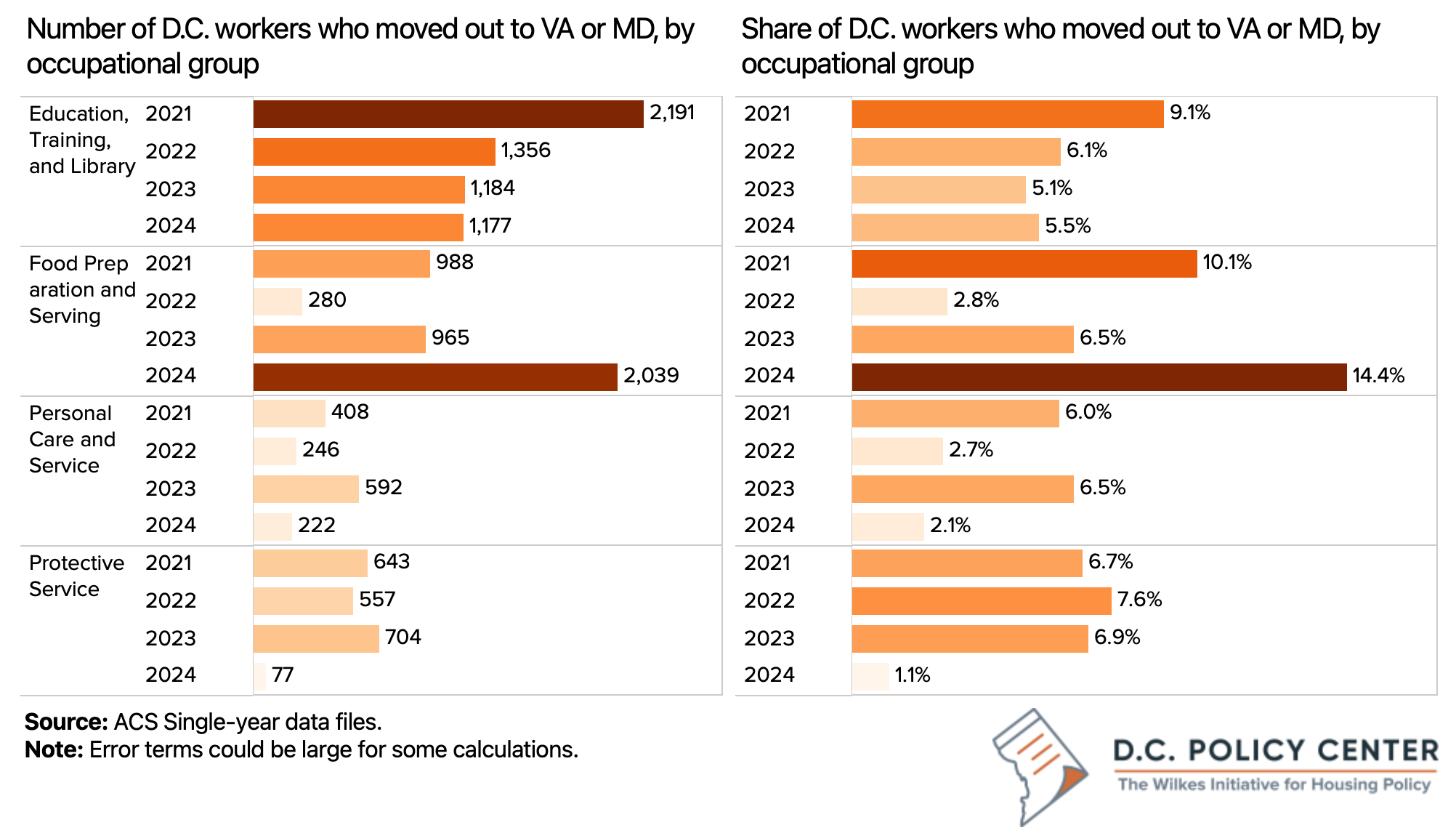
Workforce migration patterns point to a structural shift in who the city can realistically accommodate. Between 2021 and 2024, net outmigration of essential workers from the District to nearby jurisdictions in Maryland and Virginia totaled an estimated 13,629 people, or roughly a quarter of workers in those occupations who lived and worked in the District in 2024 (including those in occupations in education, training, and library; food preparation and serving; personal care and service; and protective service).5 Not every move is driven by housing, but Census data consistently show that housing costs are the most commonly cited reason residents leave the city.6
Figure 1 – Out-migration of essential workers in D.C.
Research consistently shows that when essential workers can live close to where they work, the benefits extend beyond individual convenience to workforce stability and broader economic performance. For workers, shorter commutes are associated with higher life satisfaction,7 lower stress and anxiety,8 9 better work–life balance,10 and reduced transportation costs, and proximity to high-opportunity job markets.11 For employers, shorter commuting distances are linked to lower turnover,12 reduced hiring and training costs,13 lower absenteeism,14 and higher productivity, all of which contribute to more stable service delivery.
At the city level, stronger job–housing proximity supports labor market efficiency, improves hiring outcomes, reduces vacancy rates, and strengthens long-term economic growth and tax capacity.15 Shorter commutes also reduce congestion, emissions, and infrastructure strain while improving equitable access to employment for lower-income and historically disadvantaged populations.16 Conversely, when workers are priced out and must commute long distances, cities face higher turnover, labor shortages, slower growth, and increased social and fiscal pressures.
Gaps in housing production
Despite substantial construction activity, the District’s recent housing growth has been concentrated in a narrow set of locations, building types, and price points. Between 2007, when the current construction cycle began, and 2024, the District added approximately 84,465 housing units, representing roughly a 30 percent increase in total housing stock (41 percent for the rental housing stock).
Figure 2 – Growth in the housing stock in D.C. 2007-24
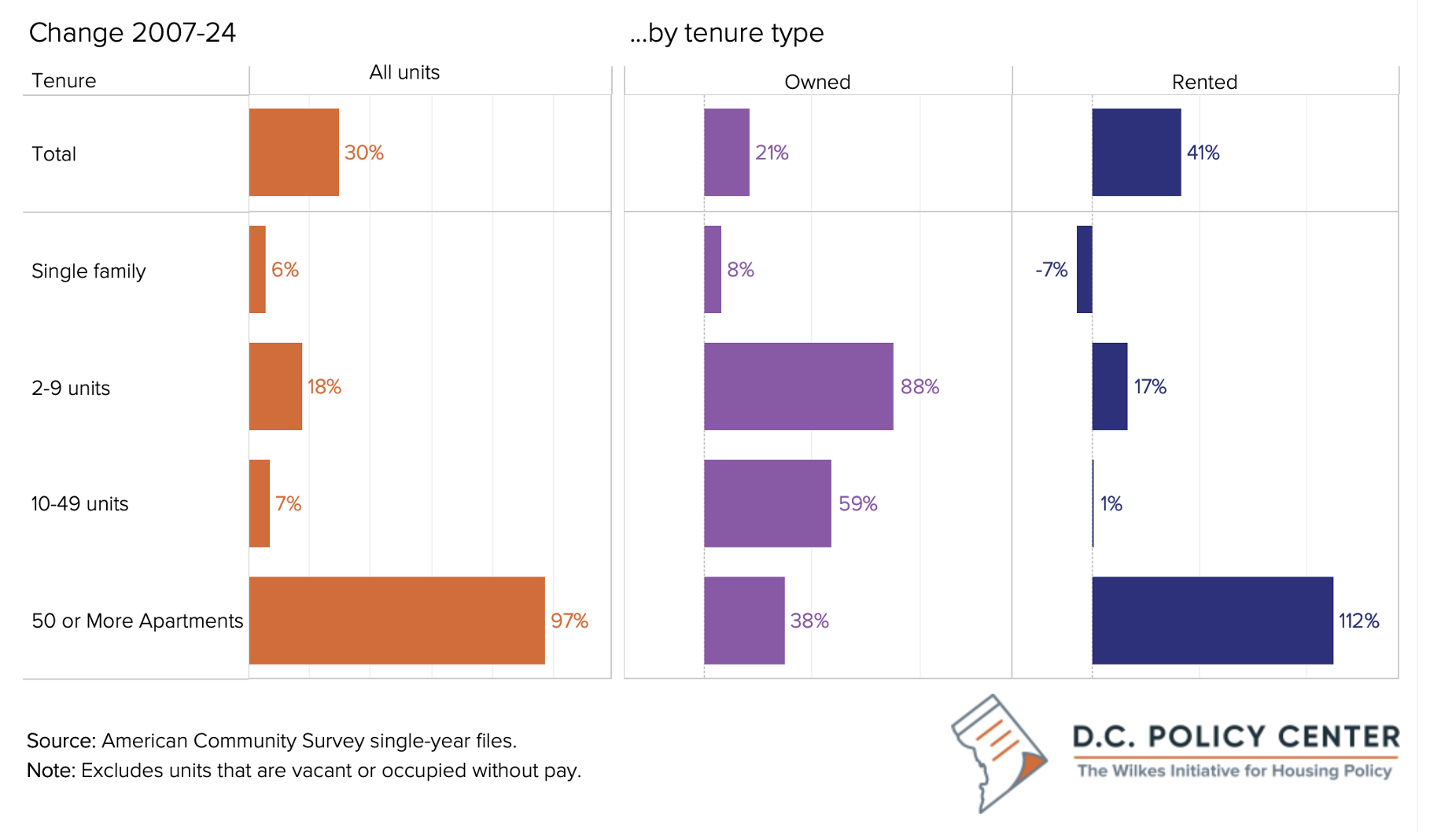
However, the composition of this growth has been highly uneven.[note]Estimated using US Census American Community Survey 1-year microdata.[/note] The vast majority of new units were small rental apartments in very large multifamily buildings with 50 or more units. The District added an estimated 65,653 units in this category alone, representing a 97 percent increase in all units and 112 percent in rental units.17 In contrast, the types of housing that often serve as entry points for middle-income households, small including single-family homes or units in small multifamily buildings, expanded by only about 12,500 units over the same period.18
New construction has also been highly concentrated, geographically. Just ten census tracts out of more than four hundred accounted for nearly one-third of all housing built during this period.19 Much of the new supply has been delivered in a narrow set of building forms: relatively small units located in large, amenity-rich buildings clustered near transit corridors or in formerly industrial areas that were rezoned for residential use.20
As a result, the city has become increasingly difficult for middle-income households to afford. Even among households earning up to 90 percent of Area Median Income, market-rate two-bedroom rental units remain largely unavailable in highly resourced areas such as Wards 1, 2, 3, and 6. For families requiring three-bedroom rentals at this income level, availability is effectively limited to Ward 8. This mismatch between where housing is built, what type of housing is produced, and what middle-income households need has become a central feature of the District’s affordability challenge.
Who is affected: A workforce and household lens
Earlier work conducted by the D.C. Policy Center shows that only a small share of District’s essential workers can realistically afford rental housing within the city. Housing affordability depends not only on wages but also on household composition, including family size and the number of earners.
American Community Survey estimates indicate that essential workers in the District have diverse household structures: roughly 47 percent are married, 23 percent have children or other family members without a spouse present, 13 percent live in non-family shared households, and 17 percent live alone. These differences matter because the ability to combine incomes often determines whether housing is affordable.
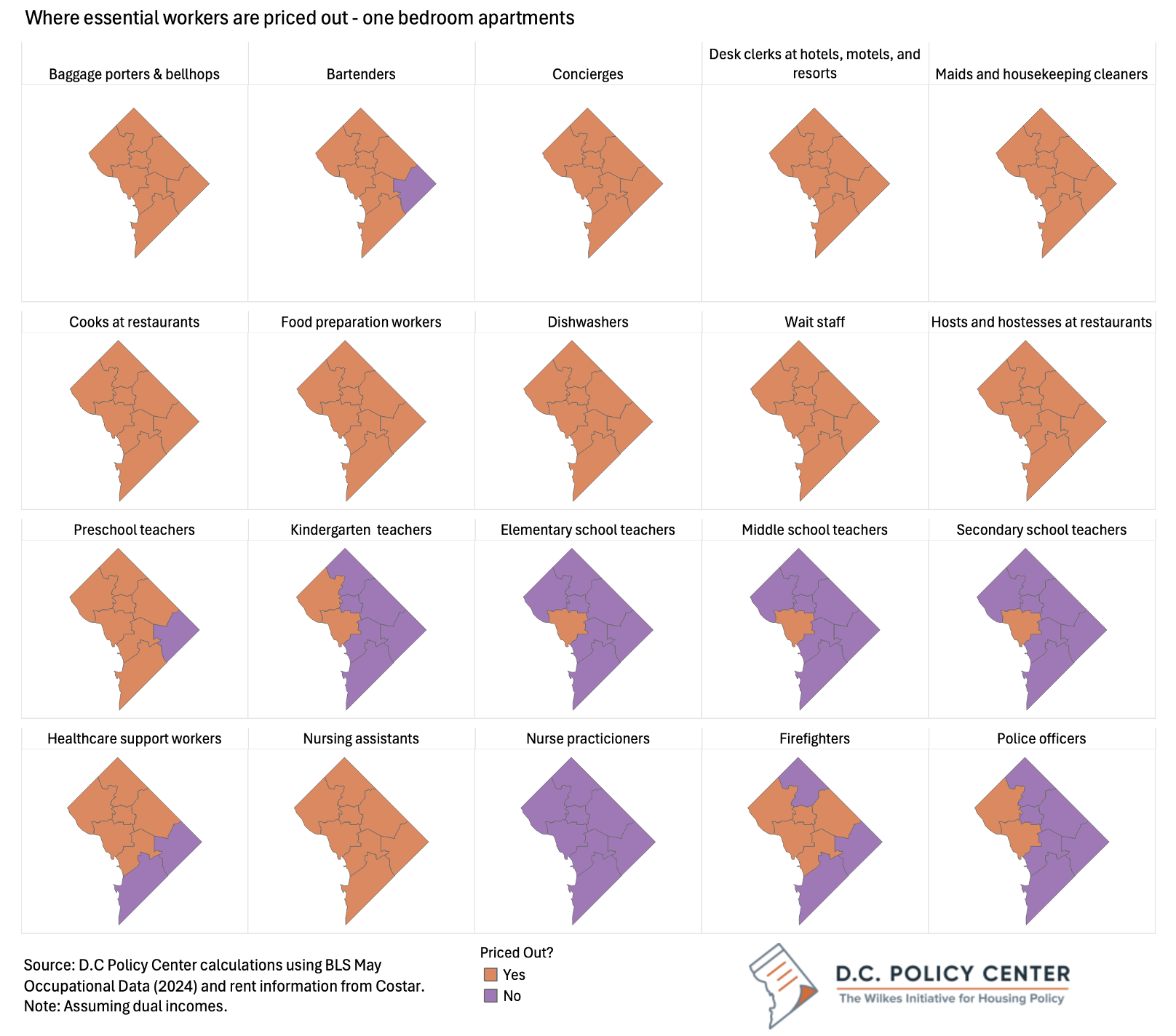
An examination of rental affordability by apartment size and ward shows that single-earner essential worker households face the greatest constraints. In most cases, a single essential worker income is insufficient to afford average rents in the District, even for one-bedroom apartments, unless shared with a roommate. Multiple earners typically make one- and two-bedroom units attainable, but larger units remain out of reach: roughly half of essential worker households are priced out of three-bedroom apartments across the city, with affordability limited largely to Wards 7 and 8.
Overall, the data indicate that for many essential workers, the District’s rental market effectively requires multi-earner households, shared living arrangements, or relocation outside the city. Workers in hotel and service industries, health care support roles, and nursing assistant positions are generally priced out of nearly all apartment types citywide when relying on a single income, including studio units. Teachers and first responders can typically afford studio apartments in many neighborhoods, but even two-earner households in these occupations often cannot afford one-bedroom units in the highest-cost wards, such as Wards 2 and 3. The pattern repeats across other essential occupations.
Figure 3 – Affordability by occupation and ward, one-bedroom apartments, by Ward
For the District, the gradual relocation of essential workers from the city to surrounding jurisdictions has implications for economic competitiveness and business location decisions. A D.C. Policy Center survey found that 62 percent of businesses in the District consider proximity to their workforce an important factor when choosing where to locate.21 When a growing share of workers must commute from outside the city, employers face higher recruitment and retention risks, and the District becomes a less reliable environment for labor-intensive services and public-facing industries. The long-term effects of worker relocation thus include slower economic growth, less diverse neighborhoods, and reduced vibrancy.22
Why current housing tools cannot close the gap
The District has developed an extensive system of housing interventions. These include subsidized production through the Housing Production Trust Fund (HPTF), regulatory set-asides through Inclusionary Zoning (IZ), federal and local vouchers (HCV and LRSP), tax abatements,23 Low-Income Housing Tax Credits (LIHTC), affordable dwelling mandates,24 and negotiated public-benefit agreements associated with public land dispositions.25 But these programs have not helped with the problem of workforce erosion.
First, existing affordability tools do not target or meet the needs of many essential workers. Housing subsidy programs are focused on the lowest income residents, leaving few options for middle-income workers. Capital subsidy programs including HPTF26 and the federal LIHTC27 target households earning 80 percent of Area Median Income (AMI) or below, focusing on affordability at or below 50 percent of AMI. While some essential workers may qualify near the top of that range, policy priorities increasingly concentrate resources on households with far lower incomes. In practice, these developments also cluster in a limited number of lower-cost neighborhoods,28 29 often outside areas with the greatest economic opportunity, impeding inclusion.
Operating subsidies face similar limitations. Programs such as the Local Rent Supplement Program (LRSP) primarily serve households with very low incomes, leaving many middle-income workers including teachers, nurses, first responders, public employees, and service-sector supervisors outside their reach.
Second, the scale of these programs are limited by slow and costly production. Per-unit costs in HPTF- and LIHTC-financed projects now significantly exceed those of comparable market-rate developments.30 31A transaction-intensive structure contributes to these outcomes: projects rely on layered financing, extensive compliance requirements, lengthy approval processes, and significant legal, design, and syndication costs.32 The complicated program design results in a small number of repeat developers who have navigated the system rather than a broader number who could compete on cost.
Third, programs that can serve essential workers are highly contentious. For example, programs that tie affordability to discretionary approvals or negotiated development conditions can generate units affordable to households in the 50 to 80 percent of Area Median Income (AMI) range, where many workforce households fall. However, these programs which include Inclusionary Zoning (IZ) implementation and Planned Unit Development (PUD) benefit negotiations are not reliable producers of such housing. Both systems depend on multi-step approval and certification processes that introduce uncertainty into development and occupancy timelines. PUD projects can face legal challenges and appeals that delay construction for months or years, while IZ units often remain vacant for extended periods as income verification, referrals, and eligibility checks move through administrative channels.
Fundamentally, these mechanisms produce housing only when discretionary approvals are sought or market-rate development proceeds. Output fluctuates with development cycles, financing conditions, and legal risk, making production episodic rather than predictable. The units that are produced also tend to cluster in higher-density zones and redevelopment corridors where development is already feasible, while large portions of the city generate little or no affordable housing.
As such, the District’s current housing tools leave a clear gap: they are not designed to deliver moderate-cost housing quickly, predictably, and at scale for workforce households. Inclusionary Conversions, the model proposed in this White Paper, aims to fill this gap. The model creates affordable units directly within the existing multifamily housing stock through acquisition or master-leasing. This approach can be deployed faster, at lower per-unit cost, and with rents targeted to workforce income levels. Inclusionary Conversions are not meant to replace the District’s existing programs, but to complement them by serving a segment of the housing market that the current system does not effectively reach.
Proposed solution: Inclusionary Conversions
Inclusionary Conversions are a workforce-housing tool that operates within the existing rental market. The model secures access to existing multifamily units through lease-based arrangements and closes the affordability gap between market rent and what eligible households can pay.
Model overview
Under the Inclusionary Conversions framework, a nonprofit intermediary links property owners, funding partners, and eligible tenants through structured lease agreements. The intermediary secures a limited number of units in existing multifamily buildings at prevailing market rents through master leasing or comparable contractual arrangements and places qualified tenants into those units at income-adjusted rents. External funders, which may include employers, philanthropies, corporations, social-impact investors, or public entities, cover the difference between the affordable tenant payment and the contractual rent.
Tenant eligibility is determined through standardized screening procedures, and program performance is tracked through ongoing monitoring of placement outcomes, subsidy utilization, and housing and employment stability.
The model functions as a structured affordability platform layered onto the existing housing stock. Because it relies on leases, it avoids many of the legal, financial, and compliance requirements that lengthen timelines and increase costs in publicly funded housing production.
Target population
Unlike traditional housing programs that anchor eligibility to income, Inclusionary Conversions begins with a more practical question: who does the city actually need to function well? The model can be tuned using occupational wage data to determine affordability thresholds for specific professions whose earnings frequently fall below what is required to access market housing in high-cost metropolitan areas, such as teachers, nurses, childcare workers, public safety personnel, and service-sector employees.
The model addresses the structural “missing middle,” both in terms of types of units, and in terms of types of households, especially those in essential occupations or whose proximity to work is valued by employers. These households may earn too much to qualify for traditional subsidy programs but too little to comfortably compete in the private rental market. As a result, they increasingly live farther from their workplaces, contributing to longer commutes, higher turnover, persistent vacancies in essential sectors and a weakening of the local workforce. Inclusionary Conversions treats proximity as an economic asset and workforce housing as part of core.
Box 1 – Who can Inclusionary Conversions serve in the District of Columbia?
| The workforce housing gap in Washington, D.C. is concentrated among workers whose wages place them above traditional subsidy eligibility but below the threshold required to access market housing comfortably. These households form the District’s operational backbone and are disproportionately employed in sectors that require physical presence rather than remote work. Public charter schools and PK–12 education staff. Teachers, paraprofessionals, aides, and administrative staff in both DCPS and the large public charter school sector face persistent affordability challenges relative to local rents. Charter networks in particular operate under tight per-pupil funding formulas and have limited ability to raise salaries to match housing cost growth. Recruitment challenges are especially acute for early-career teachers and specialized instructional staff. Universities and higher education institutions. The District’s major universities employ large numbers of non-faculty staff in student services, facilities, administration, food service, and campus operations. These positions often fall into the moderate-income band most affected by the “missing middle” housing gap. Institutions such as Georgetown, GW, American, Howard, and Catholic University face retention challenges for these roles, particularly when employees relocate to suburban jurisdictions for housing affordability. Hospitality and hotel sector. Hotels, convention facilities, and related tourism infrastructure rely heavily on workers in housekeeping, maintenance, front desk operations, and food service. These occupations generally require on-site presence and often involve early morning or late-night shifts that make long-distance commuting costly and logistically difficult. Housing instability in this sector directly affects staffing reliability and service continuity. Health systems and medical support workforce. Hospitals and outpatient systems depend on large numbers of nursing assistants, technicians, patient coordinators, transport staff, and facilities personnel. While physicians and senior clinicians typically fall outside workforce-housing eligibility, the support workforce frequently sits squarely within the affordability gap. Recruitment competition with suburban employers can be intense when commuting costs rise. Public safety support roles and city operations staff. Not only sworn officers and firefighters, but also dispatchers, maintenance crews, sanitation workers, and administrative support staff fall into income bands that often struggle with District housing costs. Retention challenges in these roles can have direct service-delivery implications for city operations. |
Economic rationale
Inclusionary Conversions are a workforce-housing tool that operates within the existing rental market. The model secures access to existing multifamily units through lease-based arrangements and closes the affordability gap between market rent and what eligible households can pay.
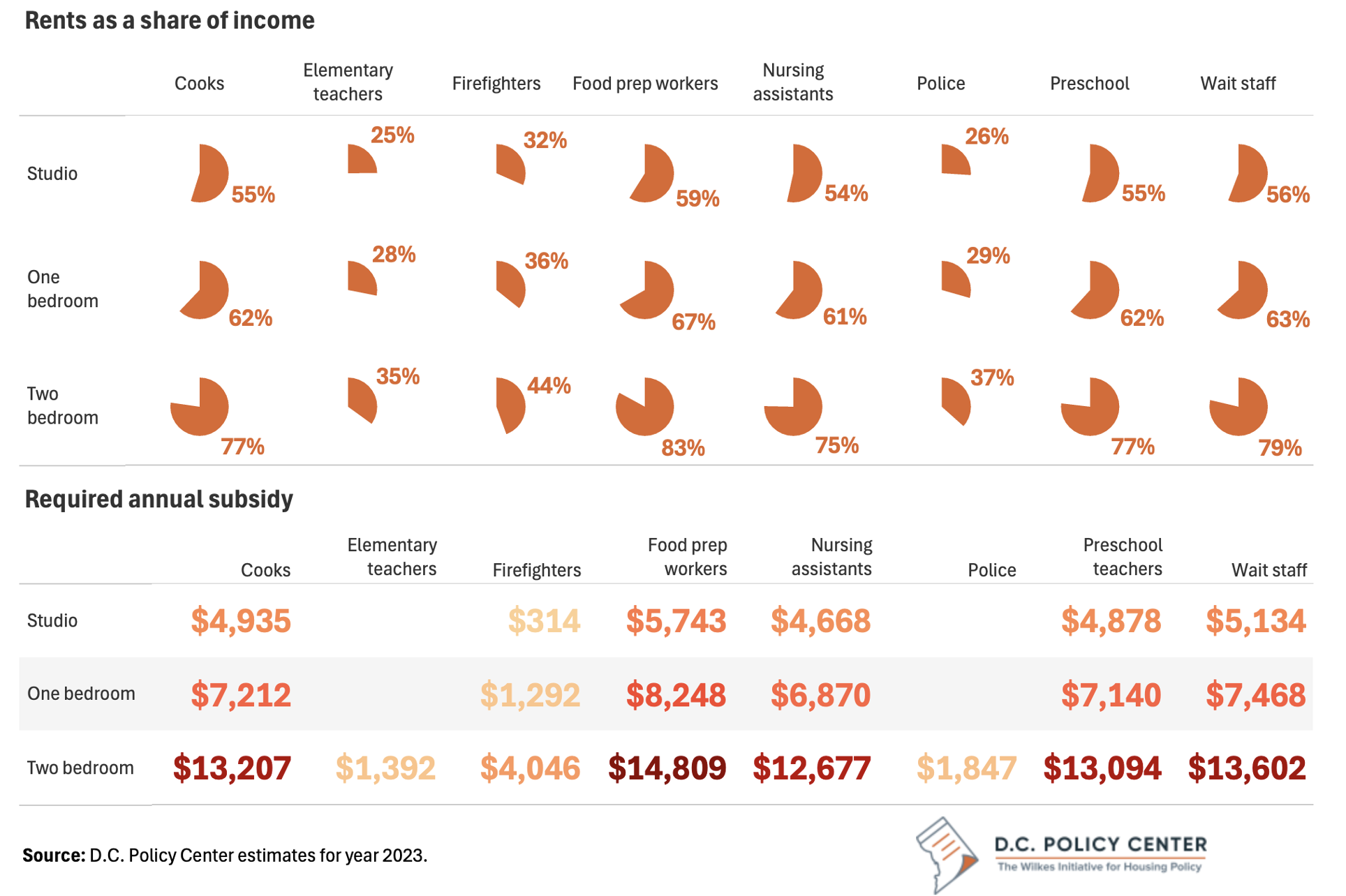
Preliminary financial modeling suggests that rent buy-downs through structured leasing can generate affordability at substantially lower cost than new production. The annual subsidy requirements for a typical unit can be measured in thousands of dollars rather than hundreds of thousands in capital investment. The contractual structure also dramatically shortens implementation timelines, which is an important advantage because there is a large value in being able to help people almost immediately. Units can be incorporated into the program through negotiated leases within weeks rather than years of property acquisition, rezoning, recapitalization, or extended underwriting cycles.
Figure 4 – Rents a share of income and illustrative annual subsidy estimates, 2023
Operational flow
The Inclusionary Conversions model follows a structured, transparent process designed to align funding, housing supply, and workforce demand.
- Identify workforce affordability gap. Program administrators define the target workforce population and estimate the difference between prevailing market rents and rents affordable at those wage levels.
- Secure funding commitments. Participating employers, philanthropies, investors, or public partners commit multi-year resources sufficient to close the identified rent gap for a defined number of units.
- Execute lease agreements with property owners. The nonprofit intermediary secures participation from multifamily housing provides through master leases or equivalent agreements. Providers receive guaranteed rents while ownership, financing, and regulatory status of the property remains unchanged.
- Place eligible tenants. The nonprofit verifies tenant eligibility using standardized criteria and matches households to available units, ensuring compliance with fair housing requirements and maintaining separation between funders and placement decisions. Allocation rules may prioritize workforce indicators including occupational categories, wage bands, or employer-verified labor shortages, but must comply with all requirements under the Fair Housing Act[33] and the District’s Human Rights Act.[34]
- Apply subsidy payments. Tenants pay income-aligned rents. The subsidy pool covers the difference between the tenant payment and the contractual market rent, ensuring full payment to property owners.
- Monitor performance and renew placements .Program administrators track occupancy, subsidy use, tenant stability, and workforce outcomes. At lease expiration, units may be renewed or returned to market status, allowing program capacity to adjust dynamically over time.
Lease structure and core contractual models for Inclusionary Conversions
The contractual relationship between the nonprofit intermediary, the property owner, and the tenant is one of the most consequential design decisions for an Inclusionary Conversions program. Two primary approaches are available: master leasing and lease guarantees (direct landlord–tenant leases with nonprofit backing). Each one addresses different operational and legal constraints. The appropriate structure depends on financing conditions, property characteristics, and program objectives. Program success depends less on selecting a single model than on aligning structure with context to improve program control, limit financial exposure, and support scalability.
Master lease. Under a master lease, the nonprofit intermediary leases a defined number of units from a property owner at market rent and subleases them to eligible tenants at income-adjusted rents, covering the difference through subsidy payments. The nonprofit becomes the tenant of record, giving it control over tenant placement and continuity of occupancy. For landlords, the arrangement offers a single counterparty and predictable rent payments. The trade-off is that the nonprofit assumes vacancy risk and payment obligations, increasing financial exposure and operational responsibility. Mortgage covenants may also limit the share of units that can be subleased, requiring lender review.
Lease guarantee. Under a lease guarantee model, tenants lease directly from the landlord while the nonprofit provides rent-gap payments and payment guarantees. The landlord–tenant relationship remains unchanged, and the nonprofit functions primarily as a subsidy administrator. This structure typically aligns more easily with lender requirements and limits nonprofit balance-sheet exposure. However, it provides less control over unit availability, since lease renewals and tenant turnover remain with the landlord, and potentially limits the value of the guaranteed income.
Box 2 – Operational comparisons of master leases and lease guarantees
| Lease structure | Solves | Considerations |
| Master lease | – Secures long-term unit control – Centralizes placement – Stabilizes inventory – Reduces landlord administration | – Requires lender consent – Increases nonprofit liability – Shifts vacancy risk – Requires stronger capitalization |
| Lease guarantee | – Preserves traditional leasing – Easier lender compliance – Lower nonprofit exposure – Easier to scale | – Reduces inventory certainty – Requires ongoing coordination – Less centralized control |
| Operational considerations | ||
| Master lease… | Lease guarantee… | |
| Is most appropriate when… | – The funders seeks multi-year certainty over unit availability, – The nonprofit has sufficient financial capacity to assume lease obligations, – Landlords have financing structures that permit subleasing, operational stability is prioritized over rapid expansion, and – The program calls for centralized placement management or coordinated service delivery | – Funders prioritize rapid geographic expansion, – The nonprofit seeks to minimize balance-sheet exposure, – Landlords prefer to maintain direct tenant relationships – Lender restrictions or financing covenants limit subleasing, and – The program operates across many buildings with small unit shares |
The choice between master leasing and lease guarantees should be viewed not as a technical or legal distinction but as a strategic design decision that affects program scale, financial risk, and control over housing inventory. In practice, the two structures solve different operational problems. Most programs will combine both approaches, using guarantees to expand across buildings and reserving master leases for locations where long-term unit control is necessary.
Hybrid application. In practice, buildings vary in financing terms, lender constraints, ownership preferences, and operational complexity. Therefore, a single contractual structure is unlikely to be appropriate across all properties and market conditions. A hybrid approach that incorporates both mechanisms provides the flexibility needed to respond to these differences while maintaining program integrity.
Under a hybrid model, lease guarantees can function as the default structure for most placements, particularly in properties with restrictive financing or where landlords prefer direct tenant relationships. Master leases can be used selectively in properties where lender consent is available and where longer-term control over units materially strengthens program stability and performance, or funders may want to invest in a certain type of property. Using this approach, the nonprofit intermediary can balance scalability while stability, allowing the program to expand across multiple properties while securing predictable inventory in locations where workforce access is most consequential.
Importantly, lease structure does not alter the affordability platform. Eligibility verification, income calculations, subsidy administration, and impact evaluations remain centralized within the nonprofit, and subsidy payments flow identically under both structures. From the tenant perspective, affordability support remains consistent even though legal lease structure differs. The hybrid model standardizes affordability delivery while allowing contractual flexibility at the property level.
Capitalization strategy
Inclusionary Conversions do not rely on upfront capital grants for construction. Instead, the model is built on lease commitments and recurring subsidy flows. Capitalization must support three parallel functions: a revolving subsidy pool, a lease exposure reserve, and a stable operating platform that signals institutional credibility to landlords, lenders, and funders.
Core subsidy pool. The primary capital requirement is a revolving subsidy pool that bridges the gap between market rents and income-adjusted tenant payments. Unlike development programs that concentrate financial exposure upfront at the point of construction, the Inclusionary Conversions model distributes exposure across annual or multi-year lease cycles. Initial capitalization can therefore support a larger number of units, provided funding streams remain predictable over multiple years.
Funding can be layered through employer contributions linked to recruitment or retention needs, philanthropic commitments, municipal participation for moderate-income, or social-impact investment vehicles structured around measurable housing outcomes. Where possible, subsidy commitments should match the full duration of each lease cycle to reduce the probability of mid-term funding interruptions.
Lease exposure reserve. Alongside the subsidy pool, the nonprofit intermediary must maintain a dedicated reserve sized to absorb short-term lease obligations during tenant turnover, placement delays, or timing mismatches in funding flows. This reserve operates similarly to a credit enhancement facility to ensure payment reliability. Landlord participation and lender comfort depend heavily on the presence of this liquidity buffer. Without it, contractual commitments will not be viewed as credible. A prudent reserve policy would:
- Link minimum liquidity thresholds to total annual lease exposure.
- Maintain coverage equal to several months of aggregate rent obligations.
- Expand proportionally as the portfolio grows.
Operating platform funding. The intermediary also requires stable operating capital separate from subsidy and reserve funds. Core responsibilities include negotiating landlord participation, verifying tenant eligibility, administering subsidy payments, monitoring regulatory compliance, and maintaining reporting and evaluation systems. These activities resemble portfolio management more than traditional social service delivery. Staffing benchmarks should therefore align with housing finance intermediaries or program-management organizations rather than service nonprofits.
Operating costs should be supported separately and not be absorbed into per-unit subsidies. Multi-year operating support during the pilot phase can help prevent administrative costs from migrating into per-unit subsidy levels.
Scaling logic
In pilot phase, the program can be launched with support from a single large employer, a seed funder, and with a single owner or a small number of properties. Over time, financing should blend employer contributions, municipal participation, and impact-oriented investment. A continuously replenished subsidy pool then replaces one-time grant capitalization and allows the program to function as a durable affordability platform embedded within the existing housing market.
Inclusionary Conversions operate within the existing multifamily stock, thus avoiding the land availability and zoning barriers that shape construction. As a result, units can be secured in mature, high-cost neighborhoods where publicly funded affordable housing has historically been difficult to deliver, whether due to limited sites, community opposition, or prohibitive development costs. This enables the model to expand access to opportunity-rich locations rather than concentrating affordability in lower-cost areas where development is easiest.
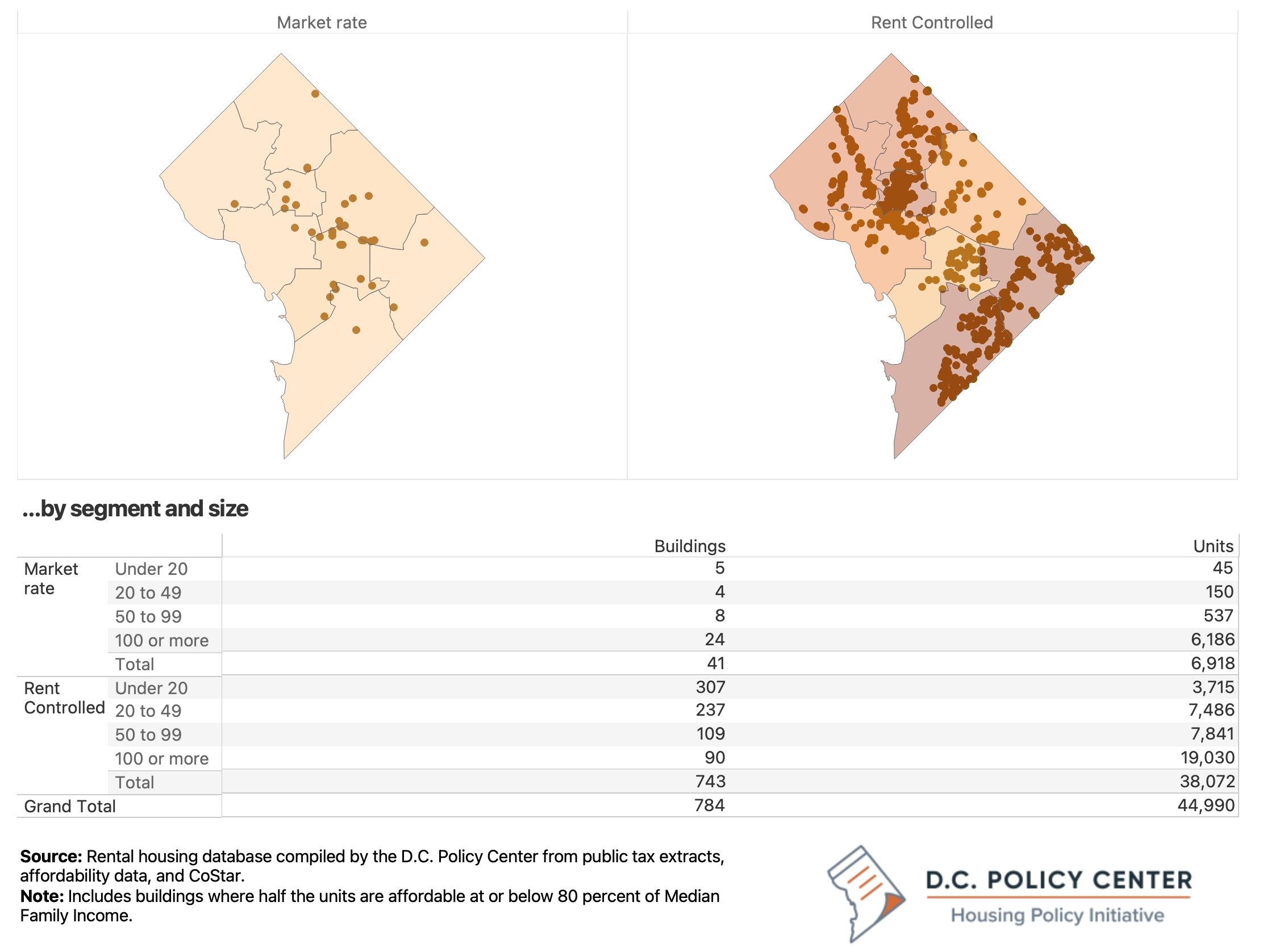
D.C. Policy Center analysis of the District’s housing stock identifies a substantial opportunity to expand affordability through existing, naturally occurring affordable housing—while also improving geographic distribution. Our earlier work identified 784 buildings, comprising approximately 44,990 units, where at least half of the units are rented at rates that make them affordable for households at or below 80 percent of area median income. This existing affordability reduces the need for deep subsidy and creates an immediate pathway to secure units in locations through Inclusionary Conversions. Of these, 502 buildings, representing roughly 36,400 units (81 percent) are located outside of Wards 7 and 8, where only 46 percent of government subsidized affordable units have been produced.33 Notably, 173 buildings with approximately 16,200 units (36 percent) are in Wards 2 and 3, which hold less than 5 percent of government subsidized units.
Converting just 5 percent of eligible units in Wards 2 and 3 would generate more than 800 workforce housing units. While modest relative to total housing need, this output would materially exceed production through the Housing Production Trust Fund in those wards, where only 29 units were delivered in a single project. These numbers illustrate that by leveraging existing rent structures in high-cost neighborhoods, Inclusionary Conversions can unlock incremental but meaningful affordability in locations where traditional subsidy-driven production has yielded limited results.
Geographic impact of the use of existing housing stock
Inclusionary Conversions operate within the existing multifamily housing stock, allowing the model to build on rent structures that already deliver partial affordability. D.C. Policy Center analysis identifies 784 buildings, comprising approximately 44,990 units, in which at least half of rents are affordable at or below 80 percent of area median income. These units represent naturally occurring affordable housing embedded across the city, including in higher-cost neighborhoods where new subsidized development is difficult to deliver. By relying on this existing stock, the model avoids the land acquisition, zoning constraints, and long development timelines that typically shape new construction.
Reduced subsidy requirements
Because a significant share of rents in these buildings is already below market peaks, the subsidy required to reach workforce affordability is materially lower than in new construction. Inclusionary Conversions close the remaining affordability gap rather than financing full development costs, allowing each dollar of subsidy to support more households. This structure creates an immediate and scalable pathway to expand affordability using existing units, particularly in locations where achieving similar outcomes through capital-intensive programs would be prohibitively expensive or slow.
Figure 5 – Market rate and rent controlled buildings where half the rents are below 80% of AMI, 2025
Expanding access to high-opportunity neighborhoods
The model introduces a mechanism to reduce the geographic concentration of affordable housing. Rather than relying on where land is available or development is feasible, Inclusionary Conversions follow existing housing stock and labor market demand. This allows affordability to be distributed more broadly across the city, including in neighborhoods with strong access to jobs, schools, and services. Over time, this can help rebalance patterns of access that have historically concentrated subsidized housing in a limited set of locations.
The geographic distribution of these naturally affordable buildings differs sharply from the pattern of publicly subsidized housing. Of the 784 eligible buildings identified, 502—representing approximately 36,400 units, or 81 percent—are located outside of Wards 7 and 8. This share is 48 percent for government subsidized housing production. This distribution indicates that a substantial share of the city’s existing affordability is already embedded in neighborhoods that have historically seen limited subsidized production.
The contrast is particularly pronounced in higher-cost areas. Wards 2 and 3 contain 173 eligible buildings with approximately 16,200 units—about 36 percent of the total—despite accounting for less than 5 percent of government-subsidized affordable housing. By comparison, nearly half of publicly supported affordable units have been concentrated in Wards 7 and 8. Inclusionary Conversions can therefore redirect a portion of affordability into high-opportunity neighborhoods without requiring new construction, expanding access to areas where traditional programs have had limited reach.
Incremental but meaningful gains
The scale of impact is incremental at the building level but meaningful in aggregate. Converting just 5 percent of eligible units in Wards 2 and 3 would generate more than 800 workforce housing units. While modest relative to overall housing need, this output would exceed recent production through traditional subsidy programs in those wards, where only 29 units were delivered in a single Housing Production Trust Fund project. These results illustrate that leveraging existing rent structures can produce tangible gains in access to high-opportunity neighborhoods, even at relatively low levels of participation.
Stakeholder participation incentives
Inclusionary Conversions require participation from landlords, tenants, employers, and funding partners. In the District of Columbia, a high-cost city with major anchor employers such as universities, hospitals, hotels, and charter school networks, housing affordability increasingly affects workforce stability, making cross-sector participation more likely.
Landlords, property owners, and housing providers.
For providers, the model offers predictable rental payments, reduced vacancy exposure, and lower tenant acquisition costs. Lease guarantees or master lease arrangements backed by a credible nonprofit intermediary can stabilize revenue, particularly in buildings with recurring turnover. Provides would require clarity on tenant screening standards, maintenance responsibilities, dispute-resolution, and lender compliance. Program design must therefore emphasize standardized procedures, transparent communication channels, and clear contractual allocation of responsibilities.
Tenants and workforce households.
For workforce households, the program expands access to neighborhoods and buildings that would otherwise be unaffordable. Living closer to employment centers reduces commute times and transportation costs while supporting greater housing stability. Program rules must ensure that housing tenure remains stable even if employment or subsidy eligibility changes.
Employers
For many District employers, housing affordability has become a labor-market constraint. Universities, hospitals, hotels, and charter schools rely on moderate-income workers whose wages often fall below market housing thresholds. Contributing to a pooled housing platform offers a more scalable alternative to direct housing stipends, allowing employers to support workforce stability without managing housing benefits internally.
Funding partners and public agencies
Philanthropic organizations, financial institutions, and public partners may view the model as a cost-effective way to expand housing access. Because the approach relies on operating support rather than capital development, each dollar can reach more households than traditional construction programs. For the District government, Inclusionary Conversions can complement existing tools by expanding access within the current housing stock while longer-term supply strategies continue.34
Box 3 – Potential groups for support and opposition
| Most likely to support | Most likely to resist or express caution |
| Large employers. Universities, hospitals, hotel operators, and charter school networks face direct workforce housing pressures. A pooled housing platform may offer a more scalable alternative to housing stipends or employer-built housing. Multifamily owners. Operators with large portfolios or recurring vacancy risk may value guaranteed rent payments and nonprofit-backed placements as a source of revenue stability. Philanthropic housing funders. Foundations focused on economic mobility or workforce access may view the model as delivering measurable housing outcomes at lower per-unit cost than construction subsidies. Fiscal pragmatists within local government. Officials concerned about the rising cost of programs such as LRSP or HPTF may see leasing-based approaches as a lower-cost complement that can deliver near-term workforce housing while supply reforms advance. | Tenant advocates. Some may worry that programs operating within existing housing stock could shift units away from unsubsidized renters or affect access to rent-controlled apartments, particularly given past concerns about voucher concentration. Small landlords. Owners of small buildings may hesitate due to administrative complexity, coordination with a nonprofit intermediary, or perceived regulatory risk unless procedures are simple and standardized. Production- and deep-affordability focused housing advocates providers. This will especially be strong if the program is perceived as competing with or taking from existing funding. Stakeholders focused on supply expansion may view leasing-based affordability as insufficiently structural. The model must therefore be positioned as a complement to, not a substitute for, new housing production. Fiscal watchdogs. Recurring subsidies may raise concerns about long-term budget exposure if public funds are involved. Caps on commitments, reserve requirements, and measurable outcomes—along with leveraging private funding—can mitigate these concerns. |
Governance, operations, and program administration
The effectiveness of the Inclusionary Conversions program depends heavily on the governance structure of the nonprofit intermediary. Governance must provide operational flexibility while ensuring accountability to funders, housing providers, tenants, and public stakeholders. To achieve scale, oversight structures should prioritize balance-sheet discipline, risk management, operational capacity, compliance controls, and performance measurement.
Key elements of governance
The non-profit should maintain formal risk policies including board-approved reserve policies tied to aggregate lease exposure; liquidity thresholds reviewed frequently, and written guidelines governing concentration risk by property or landlord. There should be separate finance and program functions by creating two distinct committees to govern each, instituting independent review of subsidy disbursements and lease obligations, and establishing internal controls comparable to those used by housing finance agencies.
The governance should emphasize portfolio-level oversight with regular reporting on total exposure, vacancy risk, and subsidy commitments, and stress testing under funding disruption scenarios. The organization should adopt transparent reporting standards including publicly reported performance metrics and independent evaluations in addition to audited financial statements, and enforce conflict-of-interest safeguards through full disclosure and recusal requirements.
Organizational classification under IRS rules.
The intermediary should be structured as a charitable nonprofit operating for public benefit under applicable federal tax-exempt frameworks. The organization should be positioned as a program administrator advancing housing access and workforce stability rather than as a direct housing provider or operator. This structure supports flexibility in program design while maintaining alignment with charitable purpose requirements. A clearly articulated mission and charitable purpose are essential to obtaining and maintaining tax-exempt status, particularly if employer contributions or sector-targeted funding play a significant role in capitalization.
Board structure and representation of funders
Governance should reflect the intermediary’s role as a multi-stakeholder platform. A typical governance framework would include independent directors with housing finance, nonprofit management, and legal expertise. Various subcommittees can include representatives from major funding partners (employers, philanthropy, or public entities), subject to conflict-of-interest safeguards, experts on workforce needs, and members with experience in tenant protections, housing policy, or community engagement.
Funder representation can strengthen long-term financial commitment and program alignment with workforce needs. However, governance documents should clearly prohibit funders from influencing tenant placement, property selection, or eligibility determinations. These operational functions should remain under standardized program criteria administered by staff.
Executive management and operational independence
Day-to-day program should be led by professional management with expertise in housing finance, portfolio risk management, compliance administration, and landlord relations. Management responsibilities typically include:
- Negotiating landlord participation agreements
- Managing lease exposure and reserve policies
- Verifying tenant eligibility under standardized criteria
- Administering subsidy disbursements
- Maintaining compliance with fair housing and local regulations
Operational independence is important for maintaining consistent application of program rules across funding sources, properties, and geographic areas.
Defining program success
Governance must establish clear, board-approved criteria for program performance grounded in clearly defined, measurable outcomes, including:
- Number of workforce households placed
- Average affordability gap closed per dollar deployed
- Tenant stability and retention rates
- Geographic distribution of placements, including access to high-opportunity neighborhoods
- Employer retention or workforce stability indicators where relevant
- Administrative cost ratios and subsidy efficiency measures
Importantly, metrics should prioritize sustained housing access rather than short-term placement volume alone.
Independent evaluation and reporting
Credibility requires separating between program administration and performance evaluation. The intermediary should establish independent evaluation mechanisms in addition to internal reporting. Evaluation mechanisms may include annual third-party program audits, external financial compliance reviews, periodic impact assessments conducted by independent research institutions, and public reporting dashboards tracking placement, cost, and stability metrics.
Independent evaluation helps reassure funders, lenders, policymakers, and the public that reported outcomes are verifiable and resources are used effectively. Transparency is especially important in a model that blends private funding, employer participation, and public-policy objectives.
Because landlords and lenders are counterparties, not beneficiaries, the intermediary must demonstrate financial discipline comparable to institutional actors. That discipline builds trust and enables scale.
Risks and implementation considerations
The potential challenges for Inclusionary Conversions are procedural and contractual design choices. This model resembles the launch of a managed financial platform layered onto existing housing stock. With standardized agreements, pilot testing, and incremental scaling, most implementation risks can be addressed though disciplined program architecture. There is also political risk, shaped by existing policies and their unintended consequences at the neighborhood level.
Financial and market risks
Lease exposure and lender constraints. Multifamily properties often operate under financing covenants (especially in agency-backed loans) that limit the share of units that may be master-leased or subleased. These provisions are standard in multifamily finance and are routinely reviewed during underwriting and compliance monitoring.
A lease-guarantee structure can reduce these constraints. Under this model, tenants lease directly from the landlord, while the nonprofit covers the rent gap and guarantees payment. Because the conventional landlord–tenant relationship remains intact, lenders generally view this arrangement as lower risk. Master leases provide stronger control over unit availability and tenant placement, but they require closer review of financing covenants and, in many cases, lender consent. In discussions with lenders and housing finance attorneys, modest concentrations (five to ten percent of a building) of master-leased units were generally viewed as manageable, with concerns emerging primarily when the share becomes large.
For these reasons, program implementation should focus on securing a limited share of units in each building, prioritize properties where lender consent is feasible, and incorporate lender review as a routine step in property selection and contracting.
Funding continuity and solvency. For the program to succeed, there should be sufficient upfront capital or a funder with sufficient capacity to ensure it can meet the program timelines.
Market participation and landlord incentives. Landlord participation is necessary for the program to scale. Guaranteed rent payments and reduced vacancy risk strengthen participation incentives. However, market conditions may still influence willingness to commit units, particularly in rapidly rising rental environments where owners anticipate substantial near-term rent growth. Program design should therefore incorporate lease durations, escalation provisions, and participation terms that remain attractive across varying market cycles.
Legal and regulatory considerations
Fair housing and workforce targeting. Workforce targeting and employer participation must comply with federal and local fair housing laws. Eligibility may be defined by occupation and income bands, but tenant placement cannot consider protected classes or rely on impermissible screening criteria.
To maintain compliance, eligibility verification should follow standardized income-based procedures managed by the nonprofit intermediary or an independent third party. If employers contribute funding, their role must remain strictly financial. They should not screen, rank, approve or assign tenants and delegate this to the nonprofit intermediary. If implemented through rent guarantees, tenant selection should remain with the housing provider under applicable law, with the nonprofit administering subsidy eligibility separately. The program should be clearly structured and communicated as an affordability initiative open to any applicant who meets eligibility criteria, not as housing tied to employer discretion.
Outreach should follow the same principle. Workforce-sector outreach may help inform potential applicants, but public materials must emphasize open application processes and neutral eligibility standards. Clear documentation of placement decisions strengthens both legal compliance and program credibility.
Legal consultations also indicate that organizational structure matters. Organizing the intermediary as a charitable program administrator rather than a direct housing operator may provide greater flexibility while maintaining nondiscrimination safeguards. Lease agreements that define the nonprofit as a subsidy administrator or contractual intermediary rather than the primary landlord can further clarify the allocation of compliance responsibilities and tenant protections, leaving most of these with the landlord.
Interaction with rent control and local regulations. District’s rent control laws regulate allowable rent increases, renewal rights, and tenant protections in covered buildings. Inclusionary Conversions can operate within this framework because affordability is delivered through third-party subsidy payments rather than through modifications to the contractual rent. Housing providers continue to receive the lawful rent under stabilization limits, while tenants pay an income-adjusted share and the program covers the remainder. The model does not modify the rent stabilization regime.
Implementation nonetheless requires careful lease structuring. Recorded rents must remain compliant. Sublease arrangements cannot create unlawful rent differentials. Tenants must retain all statutory renewal and eviction protections. Where master leasing is used, agreements must clearly specify which party is treated as the landlord for purposes of rent-control compliance and tenant protections.
Tenant stability and employment-linked eligibility. Workforce targeting or employer-supported funding can raise questions about tenant status if employment changes. A workable structure must separate housing tenure from employment continuity. In most implementations, tenants would retain their lease even if they leave the participating employer, though the subsidy may phase out based on income eligibility or program criteria. This separation protects tenant stability and avoids the risks associated with employer-controlled housing. While the risk is presumably much lower than the risk attached to, for example, Rapid Rehousing, it is real, and complicated by the tenant-landlord laws that govern the District, and therefore warrants greater investigation.
Operational and institutional risks
Administrative capacity and intermediary credibility. The nonprofit intermediary administers eligibility verification, subsidy payments, lease coordination, and performance monitoring. Institutional capacity and credibility therefore become central operational requirements. Governance structures, financial transparency, compliance protocols, and standardized operating procedures must be established early to attract landlords and secure funding commitments from employers, philanthropic partners, and public entities.
Political and perception risks
Public perception and stakeholder concerns. In the District of Columbia, every new housing subsidy program enters a civic landscape shaped by memory, by housing providers’ uneven experiences with vouchers and the Rapid Rehousing Program, and by residents’ enduring anxiety about the erosion of naturally affordable and rent-controlled housing. Workforce housing initiatives can therefore draw skepticism if they are perceived as shifting access to a limited number of units instead of increasing overall affordability.
Rent-controlled buildings sit at the center of this sensitivity. They offer affordability without formal income verification and have longed functioned as informal stabilizers for moderate-income households. Any policy that operates within this segment of the market will be examined closely not just for its legality, but for its perceived fairness. Recent enforcement actions have intensified concerns. Allegations that some landlords concentrated voucher placements in rent-controlled buildings or manipulated screening practices have contributed to a public narrative that subsidies alter who occupies existing affordable units even when the underlying problems stem from compliance failures rather than program design.
For Inclusionary Conversions, this context creates two practical obligations: the program must clearly show that it expands affordability without displacing existing tenants, and it must limit participation to a modest share of units within each building. The primary risk is therefore perceptual. Transparent rules, careful monitoring, independent evaluation, and clear communication that the program complements broader housing production efforts are essential to maintaining public confidence.
Synthesis: What the risks actually mean
D.C. Policy Center research suggest that Inclusionary Conversions are legally compatible with both rent stabilization regimes and fair housing laws, provided the program operates as a structured subsidy and leasing platform rather than as an employer-controlled housing assignment or informal placement system.
Importantly, most compliance risks relate to procedural design rather than structural feasibility. With standardized lease templates, neutral eligibility rules, and independent tenant screening administration, and a clear assignment of the responsibility for compliance with tenant laws, the model can function within existing regulatory frameworks while expanding access to workforce-affordable housing.
Next steps for the research: Implementation pathway
To date, the work has focused on conceptual design, preliminary financial modeling, stakeholder engagement, and initial legal review. The next phase must shift from concept development to implementation design
These steps confirm that the model is financially plausible and institutionally compatible with existing housing systems. The next phase of research must shift from theoretical validation toward practical implementation design.
Verify scalability
The D.C. Policy Center has already built a comprehensive rental housing database covering multifamily properties by type, location, ownership structure, unit count, and regulatory status. This work has allowed us to identify a substantial share of the District’s housing stock that could plausibly support Inclusionary Conversions under appropriate conditions.
Our initial analysis identifies approximately 370 rent-controlled properties with 50 units or more, containing about 53,700 units that could participate under appropriate program conditions. Separately, we identify 936 naturally affordable buildings, either rent-controlled or market-rate, with approximately 63,600 units in which at least half of the apartments rent at or below 80 percent of area median income.
The next stage is to sharpen this analysis by identifying which buildings are most likely to be operationally viable. This will include attention to location near job centers, evidence of leasing turnover or vacancy exposure, ownership and financing patterns, and regulatory characteristics that could affect participation.
This work will provide the first realistic estimate of the size and shape of the market for Inclusionary Conversions in the District, an assessment of interest, and available funding.
Portfolio-level financial modeling
The D.C. Policy Center has already developed preliminary subsidy models for different workforce subgroups based on prevailing rents, as well as an initial pro forma for a sample 20-unit building with one- or two-bedroom buildings. multifamily building. Those early models demonstrate the mechanics of the concept at the unit and building levels.
The next phase will extend that work into a more rigorous portfolio-level financial framework. This model will incorporate:
- vacancy exposure,
- reserve requirements,
- administrative costs,
- rent growth assumptions,
- building participation rates,
- funding durability over multi-year lease cycles, and
- sensitivity testing across different market conditions.
The goal is to determine whether an intermediary administering a portfolio of units could remain financially stable over time. This modeling will be essential for funders, policymakers, employers, and future operating partners considering whether the model can be sustained beyond a demonstration of unit-level feasibility.
Develop a pilot-ready program structure
The immediate practical priority is to translate the conceptual model into an executable operating design.
This phase of the project will define the core architecture of a future pilot, including:
- the governance structure and capitalization requirements of the nonprofit intermediary,
- standardized lease templates for both master-lease and guarantee-based arrangements,
- eligibility verification procedures,
- tenant placement protocols,
- reserve and liquidity policies,
- internal financial controls, and
- compliance procedures related to fair housing, rent stabilization, and lender review.
The output will be a pilot-ready operating framework that a sponsoring nonprofit, employer consortium, public agency, or partner institution could use as the basis for implementation planning.
Conduct property-level feasibility screening
To move beyond theory, we will test the model against actual building conditions in the District (or buildings in the inner core of the metropolitan area in close proximity to large employers). This phase will involve screening candidate properties and portfolios through engagement with housing providers to determine whether they are likely to be suitable for Inclusionary Conversions. Key questions will include:
- whether financing structures allow leasing arrangements of the type contemplated,
- what degree of lender review or consent would likely be required,
- what realistic placement share could be achieved within individual buildings,
- how lease structure choices would vary by property type, and
- what operational burdens or incentives would matter most to participating landlords.
This work will convert Inclusionary Conversions from a generalized policy concept into a property-specific deployment strategy grounded in the realities of the local housing market.
Formalize employer and funder participation pathways
Employer participation is central to the logic of Inclusionary Conversions. The model is strongest where large institutions face persistent recruitment and retention challenges linked to housing affordability and where workforce stability carries operational value.
The next research phase will therefore develop structured participation pathways for institutions such as:
- universities,
- hospital systems,
- hospitality employers,
- major service-sector employers, and
- public charter school networks.
This work will include the design of standardized employer contribution models, pooled funding structures, and participation agreements that clearly separate financial support from tenant selection decisions. It will also assess how employers think about housing as a workforce issue and what kinds of contribution structures are most realistic.
The goal is to convert general employer interest into usable implementation models that could support a multi-year pilot.
Expand legal and regulatory analysis
Preliminary legal review suggests that Inclusionary Conversions can be designed to operate within existing housing regulations. But a much deeper implementation analysis is needed before a pilot can move forward with confidence.
This phase will examine:
- nonprofit tax classification and governance requirements,
- mortgage covenant implications and lender consent procedures,
- landlord and tenant treatment under master-lease and guarantee structures,
- rent stabilization compliance,
- fair housing and anti-discrimination rules,
- workforce-targeted eligibility design, and
- related questions of documentation, liability, and institutional role.
The result will be a clearer legal framework that reduces uncertainty for landlords, employers, funders, and potential public partners.
Explore eligibility verification mechanisms
Eligibility verification for Inclusionary Conversions can be conducted by the non-profit intermediary, a trusted, independent administrator, to reduce administrative burden on property owners, and avoid conflicts of interest, particularly where employers may contribute to rent buy-downs but should not influence tenant selection. Verification can be streamlined through technology by integrating secure, API-based income verification tools that draw on payroll systems, tax transcripts, or third-party platforms (e.g., The Work Number, ID.me), combined with tenant-facing digital portals for document submission and recertification.
Design an evaluation and performance measurement framework
This project will develop an evaluation framework that identifies the metrics most relevant to assessing Inclusionary Conversions, including:
- number and type of workforce households placed,
- affordability gains per subsidy dollar deployed,
- tenant stability and retention,
- geographic distribution of placements,
- employer recruitment and turnover indicators where relevant, and
- cost comparisons with existing subsidy approaches.
Establishing this framework in advance will ensure that future pilot results can be interpreted transparently and that decisions about scale are grounded in evidence rather than anecdote.
Table 1 – Output matrix for the next steps
| Component | Core Deliverables | Goals |
| 1. Market & Property Feasibility | • District-wide inventory of eligible buildings • Ranked pipeline of candidate properties (20–50 buildings) • Participation likelihood model by property type • Priority submarkets memo | Identify where to start and which buildings are most viable for early deployment |
| 2. Financial & Portfolio Model | • Underwriting model (Excel-based) • Portfolio-level pro forma (100–500 units) • Per-unit and total subsidy estimates • Risk and sensitivity analysis memo | Define how much it costs and what funding is required under different scenarios |
| 3. Program & Institutional Design | • Intermediary governance and operating model • Standardized lease templates (master lease, guarantees, hybrid) • Tenant eligibility and placement protocols • Program operations manual | Provide a turnkey operating structure that can be implemented immediately |
| 4. Capitalization & Partnerships | • Capital stack framework (public, employer, philanthropy, impact) • Employer participation models • Target partner list and engagement strategy • Governance and risk-sharing memo | Articulate who pays and how partners participate |
| 5. Legal, Regulatory & Implementation Pathway | • Legal memo (lender constraints, fair housing, rent regulation) • Regulatory pathway document • Pilot implementation plan (sites, timeline, sequencing) • Evaluation framework (affordability, stability, outcomes) | Enable the launch of a pilot program with clear rules and metrics |
Explore national applicability
Although this white paper uses Washington, D.C. as a primary example, the Inclusionary Conversions framework is potentially applicable across a wide range of high-cost metropolitan areas. Cities with substantial multifamily housing stock, significant rent–wage gaps, and institutional employer clusters are particularly strong candidates for implementation.
Regional housing markets characterized by strong employment growth, but constrained housing supply may benefit from leasing-based affordability programs that can be deployed without waiting for construction pipelines. National replication would likely require development of standardized legal templates, financial modeling tools, and administrative protocols that local jurisdictions could adapt to their regulatory environments.
Federal or state-level policy guidance could further accelerate adoption by clarifying compliance considerations for nonprofit leasing intermediaries and workforce housing subsidy structures.
Conclusion
The District’s housing challenge reflects two structural mismatches. The housing market produces units that many essential workers cannot afford, while the city’s subsidy system largely targets households with far lower incomes, leaving much of the workforce between the market and public support, leaving behind many of the workers the city depends on every day: teachers, nurses, childcare workers, hospitality employees, public safety personnel, and other moderate-income households who earn too much to qualify for deep subsidy and too little to comfortably compete in the market. As that gap widens, the consequences extend beyond individual hardship. They appear in longer commutes, weaker retention, reduced business confidence, and a city that becomes less accessible to the workforce that sustains it.
Inclusionary Conversions offer a practical way to respond to this gap. By financing access rather than construction, the model uses existing multifamily housing stock to create workforce affordability more quickly and at lower per-unit cost than traditional production-based approaches. The model can sit alongside efforts to build more housing, reform zoning, preserve affordability, and protect the lowest-income residents. Its distinct value is in creating attainable housing for moderate-income workers in places where new subsidized production is slow, costly, or politically difficult.
That is why the model deserves serious consideration. It can align the interests of employers, housing providers, funders, and public agencies around a practical goal: keeping more of the workforce that powers the city within reach of the city itself. In a high-cost city, proximity to work is part of economic infrastructure.
Inclusionary Conversions adds an important tool to a housing system that has become too dependent on deep subsidy and slow, expensive production. The next step is disciplined testing: sharper financial modeling, building-level feasibility analysis, legal structuring, employer commitments, and clear performance measures. If that work confirms the model’s promise, Inclusionary Conversions could become a practical addition to the District’s housing toolkit and a replicable framework for other high-cost cities facing the same workforce housing challenge.
Bibliography
Aaron, S., & Gaitan, V. (2019). Four Reasons Why Employers Should Care about Housing ⋆ SALT Property. Housing Matters an Urban Institute Initiative. Retrieved from https://www.saltproperty.com/2019/09/11/four-reasons-why-employers-should-care-about-housing/
Anthony, J. (2023). Housing Affordability and Economic Growth. Housing Policy Debate, 33(5), 1187–1205. doi: 10.1080/10511482.2022.2065328
Boushey, H., & Glynn, S. J. (2012). There Are Significant Business Costs to Replacing Employees . Retrieved from https://www.americanprogress.org/article/there-are-significant-business-costs-to-replacing-employees/
Brooks, L., & Schuetz, J. (2023, September 18). Where 20 years of new housing was built in Washington, DC—and where it wasn’t. Retrieved from https://www.brookings.edu/articles/where-20-years-of-new-housing-was-built-in-washington-dc-and-where-it-wasnt/
Burge, D. (2026). Chart of the week: D.C.’s population growth slowed in 2025—and key trends are concerning. Retrieved from https://www.dcpolicycenter.org/publications/chart-of-the-week-dc-population-growth-slowed-key-trends-concerning/
Clark, B., Chatterjee, K., Martin, A., & Davis, A. (2020). How commuting affects subjective wellbeing. Transportation, 47(6), 2777–2805. doi: 10.1007/S11116-019-09983-9/TABLES/10
Edwards, C., & Brown Calder, V. (2017). Low-Income Housing Tax Credit: Costly, Complex, and Corruption-Prone (No. 79; Tax & Budget Bulletin).
Gimenez-Nadal, J. I., & Molina, J. A. (2019). Daily feelings of US workers and commuting time. Journal of Transport & Health, 12, 21–33. doi: 10.1016/J.JTH.2018.11.001
Imran, A. (2025). Projecting future births and young children in D.C. Retrieved from https://www.dcpolicycenter.org/publications/chart-of-the-week-projecting-future-births-and-young-children-in-dc/
Jilludumudi, S., & Muhammad, D. (2026). Population and Demographic Changes in DC During and After the COVID-19 Pandemic: Part 2 – The Timing of Population Changes. Retrieved from https://ora-cfo.dc.gov/blog/population-and-demographic-changes-dc-during-and-after-covid-19-pandemic-part-2-timing
Kneebone, E., & Holmes, N. (2015). The growing distance between people and jobs in metropolitan America. Retrieved from https://www.brookings.edu/wp-content/uploads/2016/07/srvy_jobsproximity.pdf
Ma, L., & Ye, R. (2019). Does daily commuting behavior matter to employee productivity? Journal of Transport Geography, 76, 130–141. doi: 10.1016/J.JTRANGEO.2019.03.008
Nichols, A., Mitchell, J., & Lindner, S. (2013). Consequences of Long-Term Unemployment.
Oguz, S. (2014). Commuting and Personal Well-being, 2014. Retrieved from https://www.researchgate.net/publication/271191327_Commuting_and_Personal_Well-being_2014
Roodberg, D. (2025). Converting Existing Housing into Affordable Rentals: A Scalable Housing Solution. In Mercatus Center. Retrieved from https://www.mercatus.org/research/policy-briefs/converting-existing-housing-affordable-rentals-scalable-housing-solution
Santelli, F. A., & Grissom, J. A. (2022). A Bad Commute: Does Travel Time to Work Predict Teacher and Leader Turnover and Other Workplace Outcomes? (No. 22–691; EdWorking Papers). Retrieved from https://edworkingpapers.com/ai22-691
Sayin, Y. (2015, June 8). Residents Move into the City for Jobs, Move out for Housing. District Measured. Retrieved from https://ora-cfo.dc.gov/blog/residents-move-city-jobs-move-out-housing
Sayin, Y. (2019). The economic costs of land use regulations. Washington, D.C. Retrieved from https://www.dcpolicycenter.org/publications/economic-cost-land-use/
Sayin, Y., & Calma, E. (2024). Priced out: Where can D.C.’s essential workers afford to live? Retrieved from https://www.dcpolicycenter.org/publications/priced-out-where-can-d-c-s-essential-workers-afford-to-live/
Stacy, C., Meixell, B., & Serena, L. (2019). Too Far from Jobs: Spatial Mismatch and Hourly Workers. doi: 10.1086/344129.PDF Trueblood, A. (2024). Housing for workforce is a key economic development program. Retrieved from https://www.dcpolicycenter.org/publications/housing-for-workforce-is-a-key-economic-development-program/
About the D.C. Policy Center
The D.C. Policy Center is an independent, nonpartisan think tank, working to equip decision-makers with rigorous, fact-based, and unbiased analysis to support a strong, competitive, and inclusive local economy.
Through objective research and collaboration, the D.C. Policy Center develops and tests policy ideas, shares its findings, and engages in constructive dialogue to advance practical, evidence-driven solutions for residents, workers, and businesses.
About The Wilkes Initiative on Housing Policy
Launched in March 2025, the Wilkes Initiative for Housing Policy builds on the D.C. Policy Center’s commitment to advancing practical, data-driven solutions to the District’s housing challenges. Named in honor of Founding Chairman Charles “Sandy” Wilkes, the Initiative reflects his enduring commitment to expanding opportunity through thoughtful, evidence-based policy.
The Wilkes Initiative focuses on the structural drivers of housing supply, affordability, and access. It examines how housing policy shapes the District’s economic and social landscape and develops solutions to support a more vibrant, inclusive, compelling, and competitive city.
Acknowledgements
This report was made possible through the generous support of J Willard and Alice S Marriott Foundation, Huron Philanthropies, Diane and Norman Bernstein Foundation and Arnold Ventures.
The authors are grateful to David Roodberg for providing support in proforma development and analysis. We are grateful to Fred Klein, Brian Winterhalter and DLA Piper for their pro bono support. Any remaining errors are the responsibility of the authors.
Endnotes
- Trueblood (2024).
- See Jilludumudi et al. (2026). While overall tax filer numbers increased in 2024, the income buckets for in-flows and out-flows are not available for that year.
- Imran (2025).
- Burge (2026).
- Data from U.S. Census Bureau, American Community Survey calculated for essential occupations covered in Sayin et al. (2024).
- Sayin (2015).
- Clark et al. (2020).
- Aaron et al. (2019).
- Research shows that benefits diminish with longer commute times and distances (Oguz, 2014).
- Gimenez-Nadal et al. (2019).
- For example, in 2023, dental assistants in D.C. earned a 7 percent premium over dental assistants across the entire Washington metropolitan area. This premium was 6.5 percent for nursing assistants and 6 percent for preschool teachers. When workers, especially less credentialed ones are priced out of employment centers, they miss out on better paying job opportunities (Stacy et al., 2019).
- Santelli et al. (2022).
- One study estimates that turnover costs an average of one-fifth of an employee’s yearly salary because of costs associated with hiring, training, and lost productivity (Boushey et al., 2012).
- Ma et al. (2019).
- Anthony (2023).
- See, for example, Kneebone et al. (2015) and Nichols et al. (2013).
- Brooks et al. (2023).
- D.C. Policy Center analysis of ACS data.
- Ibid.
- This includes Union Market, Navy Yard, and the Wharf.
- D.C. Policy Center Business Sentiments Survey, 2024 Q 2. Responses are weighted by industry.
- Sayin (2019).
- “§ 47–860. Tax Abatement for Affordable Housing in High-need Affordable Housing Areas.” Council of the District of Columbia, code.dccouncil.gov/us/dc/council/code/sections/47-860.
- Affordable Dwelling Units (ADUs) are locally regulated for-sale and rental homes reserved for households within certain income ranges and offered below market rates. In D.C., DHCD oversees and enforces these requirements. ADUs are typically created in return for zoning relief, tax incentives, public funds, or access to District-owned land. Their rules—such as affordability periods, income limits, and resale restrictions—are defined in legal documents (deeds, covenants, land disposition agreements, ADU plans). These terms used to be negotiated case by case but are now becoming more standardized. They do not include units restricted by federal programs (like HOME, LIHTC, CDBG) or those funded by the Housing Production Trust Fund. For details see ADUs are typically created in return for zoning relief, tax incentives, public funds, or access to District-owned land. Their rules—such as affordability periods, income limits, and resale restrictions—are defined in legal documents (deeds, covenants, land disposition agreements, ADU plans). These terms used to be negotiated case by case but are now becoming more standardized.
- Together, these tools represent more than $1 billion of public investments in housing affordability annually, with roughly $727 million devoted directly to subsidies. For details, see DC Council: Office of the Budget Director. (2024). D.C.’s Commitment to Affordable Housing. https://www.dccouncilbudget.com/dcs-commitment-to-affordable-housing
- Housing production trust funds are a critical tool used by governments to finance the development and preservation of affordable housing. These funds can support a range of activities, including capital subsidies, below-market loans, and operating assistance. In Washington, D.C., the Housing Production Trust Fund (HPTF) serves as the city’s primary vehicle for creating and preserving affordable housing. Administered by the Department of Housing and Community Development (DHCD), the HPTF is funded by deed recordation and transfer taxes as well as general fund allocations.
- Housing developers can claim LIHTC on their federal income tax return for a period of ten years, and their projects are required to meet certain low-income use requirements for thirty years. There are three ways that project owners can meet the low-income means testing requirement: having at least 20 percent of their units occupied by tenants earning 50% of the area median income (AMI), having at least 40% of their units occupied by tenants with income averaging no less than 60% AMI, or having at least 40% of their units occupied by tenants with an income of 60% or less AMI. Units are kept affordable for a period of 30 years.
- Affordable Housing dataset, available at Open data from https://opendata.dc.gov/datasets/affordable-housing/
- No units have been built west of rock creek park. https://www.novoco.com/public-media/documents/district-columbia-lihtc-properties-through-2023-072025.pdf
- Edwards et al. (2017).
- HPTF contributions now average more than $530,000 per unit based on data from 7 major rehabilitation and new construction projects reported in the 2022 Annual Report for the Housing Production Trust Fund. These projects collective collectively cost $769 million to produce 1,443 units. This is the full cost of the project, funded through multiple funding streams in addition to HTPF. The $1 m figure comes from Thompson, S. (2025, June 7). In D.C., publicly funded homes can cost over $1 million per unit – The Washington Post. The Washington Post. https://www.washingtonpost.com/dc-md-va/2025/06/06/these-publicly-funded-homes-poor-cost-12-million-each-develop/
- Especially in the case of LIHTC. While municipal risk is reduced because credits are realized only after completion and lease-up, much of the financial value generated by the program accrues to transaction participants rather than directly lowering per-unit housing costs (Roodberg, 2025).
- DC Government Affordable Housing dataset.
- The District has already experimented with similar mechanisms through programs such as Cash for Covenants, which demonstrated that contractual affordability tools can operate alongside traditional production programs.