
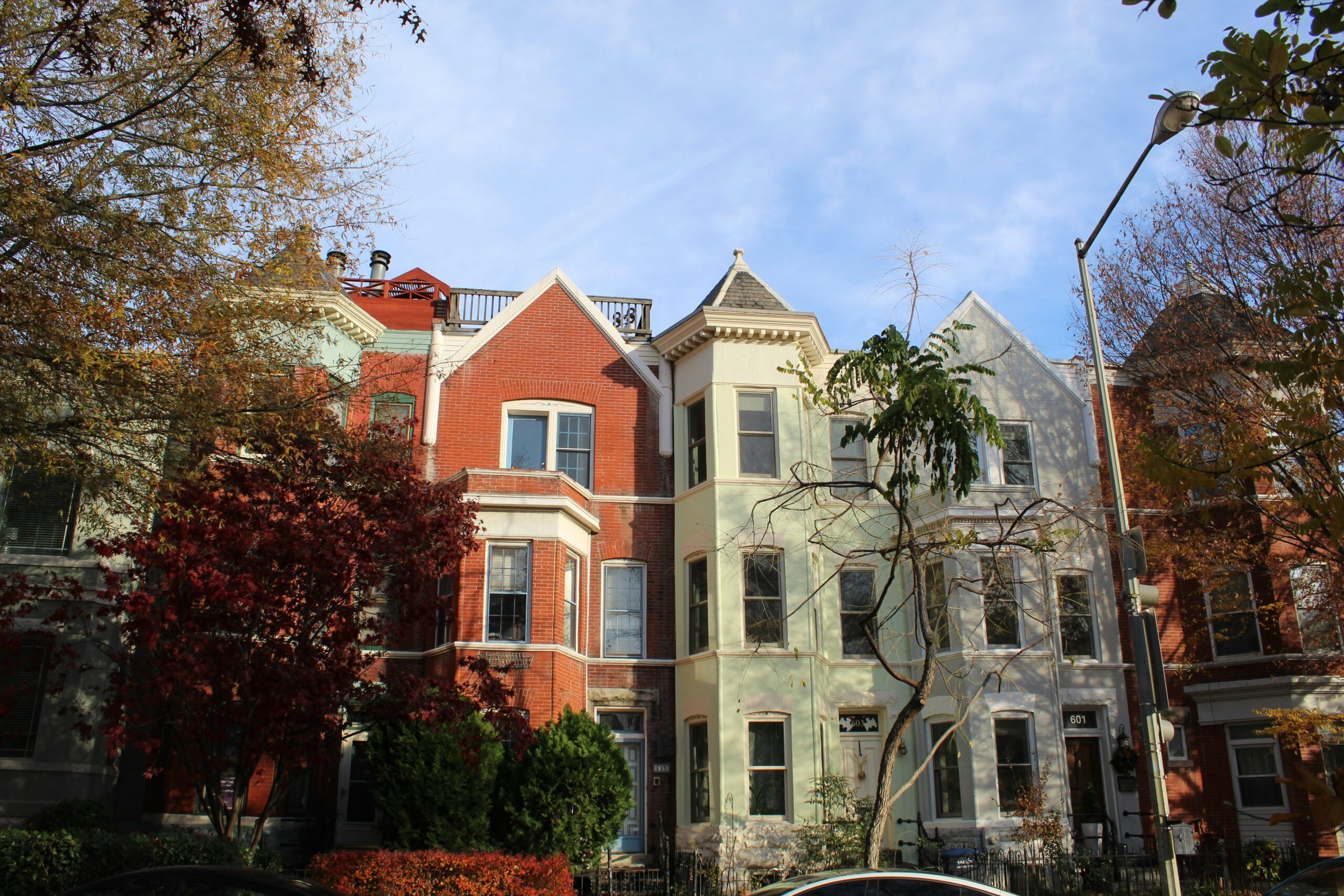
On January 27, 2026, Executive Director Yesim Sayin testified before DC Council in support of Bill 26-0227 – “One Front Door Act of 2025.” Her testimony focused on reducing unnecessary barriers to housing production and preservation in the District. Read the complete testimony below, or download a pdf version.
Good morning, Chairman Mendelson and members of the Committee of the Whole. My name is Yesim Sayin, and I am the Executive Director of the D.C. Policy Center, an independent, nonpartisan think tank focused on policies advancing a growing, vibrant and compelling District of Columbia.
I am here today in support of Bill 26-0227, the “One Front Door Act of 2025.”
The bill takes an appropriate, targeted step toward reducing unnecessary regulatory barriers to modest-scale housing production. By directing the Construction Codes Coordinating Board to permit certain residential buildings up to six stories to be served by a single means of egress, the bill moves the District’s building code closer to emerging national standards and long-standing practice in peer jurisdictions.[1]
The District currently follows International Code Council (ICC)–based provisions that generally limit single-stair residential buildings to three stories.[2] While this approach has been common in the United States, it is increasingly an outlier—both internationally,[3] and within peer U.S. cities that are modernizing their safety frameworks. New York City has long allowed single-stair apartment buildings up to approximately six stories, without evidence of higher fire-related fatality rates for these buildings relative to other residential types. [4] Proposed updates to the International Building Code would similarly allow single exits in certain R-2 occupancies up to four stories, and multiple U.S. jurisdictions have already adopted comparable reforms.[5]
Allowing single-stair buildings at modest heights does not create a new class of high-risk construction. It enables small walk-ups and adaptive reuse projects to be built more efficiently—projects that sit squarely between single-family homes and high-rise towers. These are precisely the housing types that many neighborhoods say they want and that the District chronically underproduces.
Single-stair reform should be understood as part of a broader need to recalibrate the District’s building codes towards proportionality. Over successive code cycles, the District has layered local amendments[6] onto already stringent base codes,[7] often increasing cost and complexity without corresponding life-safety benefits—particularly for small and mid-sized residential projects. As the District moves through the next code update, the Construction Codes Coordinating Board should adopt updated ICC base codes promptly and with no local amendments without a proven safety concern.
The District should also more fully utilize the International Existing Building Code (IEBC). Although D.C. has adopted the IEBC, [8] many alteration, change-of-use, and addition projects continue to be reviewed as if they were new construction. That practice triggers expensive upgrades that frequently make reuse financially infeasible. National research and local experience[9] show that code-driven upgrade requirements are among the primary constraints on adaptive reuse, including office-to-residential conversions.[10] Making IEBC compliance pathways the default for reuse projects, clarifying when full structural upgrades are required, and expanding the use of performance-based compliance would better align regulatory practice with the intent of the code.
Similar proportionality concerns arise in the District’s energy and green construction requirements. D.C. eliminated the “Simplified/Small Building Option” from its energy code in 2017.[11] At the same time, the District applies its Green Construction Code on top of the International Building Code for multifamily buildings over four stories, layering additional envelope, solar-ready, and EV-ready mandates onto already demanding standards. The result is that relatively small apartment buildings are often subject to compliance regimes designed for very large projects—producing high per-unit costs that do not scale with building size.
The District should reinstate a simplified or small-building energy compliance pathway, or create a comparable local alternative, for small multifamily, mixed-use infill, and modest conversions and additions. One option is to offer simple “pre-approved” packages that do not require full energy modeling or bespoke engineering. This could reduce cost and uncertainty while preserving performance goals.
The city could also consider eight stories as a potential calibration point for its Green Construction Code. Mid-rise buildings—typically 4 to 7 stories—are the backbone of neighborhood-scale housing. These projects do not have the scale to absorb costly envelope requirements, complex solar-ready roof design, or EV-ready infrastructure without reducing unit count or raising rents. Other jurisdictions recognize this difference in scale: Seattle[12] and Portland[13] exempt from some green provisions or offer tailored standards for small multifamily projects. from some green provisions and Instead, these cities use incentive tiers to encourage higher performance. Houston and Phoenix[14] rely primarily on the base energy code for mid-rise buildings, reserving more stringent standards for large commercial towers. In California,[15] Tier 2 green building standards (CALGreen) become effectively feasible only as buildings get larger; many small infill developers opt for the base code because higher tiers impose disproportionate costs.[16]
Restoring a simplified energy-code compliance path for small residential projects and calibrating mandatory green construction overlays to larger buildings would reduce unnecessary costs while preserving the District’s core energy-performance objectives.
Finally, the District should establish a clear, proportionate regulatory pathway for accessory dwelling units (ADUs). ADUs are permitted as-of-right in most residential zones. But on lots zoned for multiple units, they are frequently regulated as two-family conversions, triggering requirements that exceed the risk profile of a single accessory unit. [17] A tailored code path for a primary dwelling plus one accessory unit would better reflect scale and use, reduce uncertainty for homeowners, and encourage safe, legal construction.
Taken together, these reforms would not weaken safety or climate goals. They would make the code more legible, proportional, and outcome-focused—unlocking modest-scale housing in existing neighborhoods and allowing the District to grow without unnecessary cost or disruption.
References:
Axis Architecture + Interiors (2025) Navigating The DC Building Permitting Process. Available at: https://www.axis-architects.com/navigating-the-dc-building-permitting-process/ (Accessed: December 7, 2025).
Bernstein, T. (2008) Municipal Green Building Policies: Strategies for Transforming Building Practices in the Private Sector , Environmental Law Institute. Available at: https://www.eli.org/research-report/municipal-green-building-policies-strategies-transforming-building-practices (Accessed: December 7, 2025).
DC Office of Planning (2020) Assessment of Commercial to Residential Conversions in the District of Columbia. Available at: https://planning.dc.gov/sites/default/files/dc/sites/op/page_content/attachments/Assessment%20of%20Commercial%20to%20Residential%20Conversions%20in%20the%20District%20of%20Columbia_Q2%202020.pdf (Accessed: December 1, 2025).
District of Columbia Government (2020) Building Code District of Columbia. Available at: https://dob.dc.gov/sites/default/files/dc/sites/dob/publication/attachments/2017%20District%20of%20Columbia%20Building%20Code_Part%201.pdf (Accessed: November 30, 2025).
Hatchett, C. (2025) States Advance Single-Stairway Reforms to Expand Housing. Available at: https://www.pew.org/en/research-and-analysis/articles/2025/11/04/states-advance-single-stairway-reforms-to-expand-housing (Accessed: January 21, 2026).
HUD (2023) Office to Residential Conversions, Evidence Matters. Available at: https://doi.org/10.1108/02630800911002611/FULL/HTML.
Maryland Department of Planning (2024) Accessory Dwelling Unit Policy Task Force Final Report RE: ACCESSORY DWELLING UNIT POLICY TASK FORCE FINAL REPORT. Available at: https://planning.maryland.gov/Documents/Our-Engagement/ADUPTF/2024-ADU-PTF-report.pdf (Accessed: January 20, 2026).
National Trust for Housing Preservation (2011) The Greenest building: Quantifying the environmental Value of building reuse. Available at: https://living-future.org/wp-content/uploads/2022/05/The_Greenest_Building.pdf (Accessed: January 21, 2026).
Roman, J. (2024) “Single Stair, Many Questions,” NFPA Journal, 6 August. Available at: https://www.nfpa.org/news-blogs-and-articles/nfpa-journal/2024/08/06/the-single-exit-stairwell-debate (Accessed: January 20, 2026).
The Pew Charitable Trusts (2025) Small and medium multifamily housing: affordability and availability, Housing Studies. Routledge. Available at: https://doi.org/10.1080/02673037.2020.1842339.
[1] Bill 26-0227, One Front Door Act of 2025, § 2.
[2] International Code Council, International Building Code (2018/2021 editions), § 1006 (means of egress requirements).
[3] Building codes in many peer countries routinely permit single-stair residential buildings at heights well above what is currently allowed in most U.S. jurisdictions. In France, single-stair buildings are permitted up to ten floors, and in Germany and South Korea up to twenty floors. These international examples are often cited to illustrate that higher single-stair limits can coexist with strong fire safety outcomes. That said, direct comparisons should be made cautiously. Construction practices differ substantially across countries—U.S. mid-rise residential buildings are more likely to use combustible materials such as timber, while many European and Asian buildings rely more heavily on non-combustible materials like masonry or concrete. In addition, fire-related mortality data are not reported consistently across jurisdictions. In the United States, fire deaths are typically disaggregated by building size (one- and two-unit structures versus larger multifamily buildings), while many European countries report aggregate figures. These differences complicate efforts to draw one-to-one conclusions from international experience (Roman, 2024)
[4] (The Pew Charitable Trusts, 2025)
[5] A proposal in the 2024 International Building Code revision process sought to allow single-exit R-2 up to six stories, but ultimately IBC Means of Egress Code Committee approved a compromise proposal (their summary is: single-stair as tall as four stories, with constraints). International Code Council, Group A Proposal CAH22-01 (2024 IBC code development cycle); see also (Hatchett, 2025).
[6] (District of Columbia Government, 2020)
[7] (IBC, IRC, IEBC, IECC, etc.), ASHRAE 90.1-2013, and 2014 NEC.
[8] The District has adopted the International Existing Building Code (IEBC) for repairs, alterations, changes of use, and additions, with multiple compliance paths—including a “performance” path focused on outcomes rather than rigid prescriptive rules. But the performance path remains underutilized.
[9] See, for example (Maryland Department of Planning, 2024)
[10] See, for example, (National Trust for Housing Preservation, 2011). Also see (DC Office of Planning, 2020; HUD, 2023)
[11] In D.C.’s 2017 Energy Code, the “Simplified/Small Building Option” (ASHRAE 90.1-2013 / 2015 IECC ) was removed.
[12] Seattle Department of Construction & Inspections, Green Building Standard – Overview, City of Seattle, https://www.seattle.gov/sdci/permits/green-building/green-building-standard-overview (last visited Dec. 8, 2025); see also Seattle Department of Construction & Inspections, Green Building – Permit Incentives, City of Seattle, https://www.seattle.gov/sdci/permits/green-building (last visited Dec. 8, 2025).
[13] Portland Housing Bureau, HOU-1.07 – Portland Housing Bureau Affordable Housing Green Building Policy (BCP-HOU-1.07), City of Portland, https://www.portland.gov/phb/phb-affordable-housing-green-building-policy (last visited Dec. 8, 2025); see also City of Portland, PHB Affordable Housing Green Building Policy – Update 1, https://www.portland.gov/phb/documents (last visited Dec. 8, 2025).
[14] City of Phoenix Planning & Development Department, Phoenix Green Construction Code, City of Phoenix (effective July 1, 2011), https://www.phoenix.gov/administration/departments/pdd/tools-resources/codes-ordinance/phoenix-green-construction-code.html (last visited Dec. 8, 2025); see also City of Phoenix, Building Construction Code – 2018 City of Phoenix Building Construction Codes, https://www.phoenix.gov/administration/departments/pdd/tools-resources/codes-ordinance/building-code.html (last visited Dec. 8, 2025); City of Phoenix, 2012 Green Construction Code Amendment – Section 101.2 (Voluntary Compliance), https://www.phoenix.gov/content/dam/phoenix/pddsite/documents/codes-ordinances/igcc_amend.pdf (last visited Dec. 8, 2025).
[15] California Department of Housing & Community Development, 2022 CALGreen Tier 1 Residential Measures (Effective July 1, 2024), https://www.hcd.ca.gov/sites/default/files/docs/building-standards/CALGreen/hcd-shl-625a-rev-0824.pdf (last visited Dec. 8, 2025); California Department of Housing & Community Development, 2022 CALGreen Tier 2 Residential Measures (Effective July 1, 2024), https://www.hcd.ca.gov/sites/default/files/docs/building-standards/CALGreen/hcd-shl-625b-rev-0824.pdf (last visited Dec. 8, 2025); International Code Council, 2022 California Green Building Standards Code (CALGreen), Appendix A4 – Residential Voluntary Measures, https://codes.iccsafe.org/content/CAGBC2022P3/appendix-a4-residential-voluntary-measures (last visited Dec. 8, 2025); see also CALGreen Energy Services, 2022 CALGreen Tier 1 and Tier 2 EV Requirements (Aug. 24, 2022), https://calgreenenergyservices.com/2022/08/24/2022-calgreen-tier-1-and-2-ev-requirements (last visited Dec. 8, 2025).
[16] (Bernstein, 2008)
[17] D.C.’s Existing Building Code amendments push retroactive sprinklers into a broad class of Level 3 residential alterations, and tie additions to full Chapter 9/IRC sprinkler rules with only narrow exceptions. Thus, they treat ADUs and 2-unit conversions essentially like any other two-family dwelling for fire-protection purposes, without ADU-specific carve-outs (Axis Architecture + Interiors, 2025).