
On Thursday, October 22, 2026, Executive Director Yesim Sayin testified before the Committee on Housin, at its public hearing on B26-0822, the Understanding the Cost of Housing Regulations Act of 2026. Her testimony focused on how the District has never systematically measured, in dollars and in time, the cumulative cost of building and operating housing. She encouraged the Committee to establish an independent review of the District’s housing development costs as well as a comparison with peer jurisdictions.
Read the complete testimony below or download a PDF copy.
Good morning, Chairperson White and members of the Housing Committee. My name is Yesim Sayin, and I am the Executive Director of the D.C. Policy Center, an independent, nonpartisan think tank conducting fact-based research and analysis to support a strong, competitive, and compelling District of Columbia.
The Policy Center strongly supports B26-0822. The bill asks a question the District has never systematically asked: what does it cost, in dollars and in time, to build and operate housing here, and how does that compare with our neighbors in Maryland and Virginia? Today the District regulates housing heavily but does not measure the cost of that regulation. You cannot manage what you do not measure.
My testimony draws on our May 2026 report, Breaking the scarcity-subsidy cycle: A new housing vision for the District of Columbia. It also reflects interviews with 19 stakeholders.
The problem: rules were adopted one at a time, never assessed together
The District’s housing outcomes are the product of accumulated policies, not unified design. Zoning, historic preservation, tree protections, building codes, energy mandates, utility and public space rules, permitting, tax assessments, and rental regulations were each adopted to address a real concern at a particular moment, with little consideration of what they cost when stacked on a single project. Each step may be manageable. Together they make it harder to build and operate housing in the District.
This matters most for the projects the city most wants. Large, well-capitalized developments may be able to absorb delay and complexity in a strong market. Smaller builders, nonprofit providers, moderate-scale buildings, accessory units, and office-to-residential conversions cannot. Process rules also rarely reflect any cost-benefit discipline. New steps are added ad hoc, without testing their effect on housing feasibility.
The timing is urgent. In 2025, the District permitted only 1,372 multifamily units, down from 5,000 to 8,000 a year just a few years earlier. Early 2026 numbers are slightly better (1,261 permits in the first seven months),[1] but do not signal a recovery. Higher interest rates and construction costs mean that regulatory friction that builders could once absorb now stops projects outright.
Housing buildings and operators described more than 100 compounding requirements hindering projects.
To understand how these rules land on real projects, the D.C. Policy Center interviewed 19 stakeholders between July and November 2025, including market-rate and affordable developers, nonprofit housing providers, property managers, architects, lenders, and land use attorneys. We asked each to walk us through the specific requirements, reviews, and processes that added cost, time, or uncertainty to their work.
The same phrase came up repeatedly: “death by a thousand cuts.” No single rule was blamed for stopping housing. Interviewees described an accumulation of requirements, each defensible on its own, that together make projects too slow, costly, or risky to finance or operate. One developer described a project where the bank would not tolerate the uncertainty of a design review the zoning technically allowed. Others told us owners are discussing mothballing older buildings rather than finance energy retrofits required for redevelopment.
We logged every issue stakeholders raised: 106 distinct issues across zoning, building and fire codes, permitting, energy rules, utilities, tax assessments, subsidy programs, building operations, and landlord-tenant processes. Two-thirds of stakeholder comments described added cost. The rest described delay, uncertainty, or projects that never happened. More than half concerned operating existing buildings, not just new construction. The issues touch about 20 agencies, boards, and utilities, led by the Department of Buildings (DOB), the Department of Energy & Environment (DOEE), and the District Department of Transportation (DDOT). Few, if any, of these agencies have the production and operation of housing as a key mission, so they rarely weigh how their decisions affect housing affordability.
We then traced each issue to its legal source in the D.C. Code or the D.C. Municipal Regulations. Six are market conditions such as insurance and labor costs, though some of these are shaped by other policies. The remaining 100 are split by who can fix them: 36 are written into law and need Council action, 31 involve regulations an agency can change through rulemaking, 32 are agency practices that need no legal change but do require stronger operational capacity, and one rests with Congress.[2]
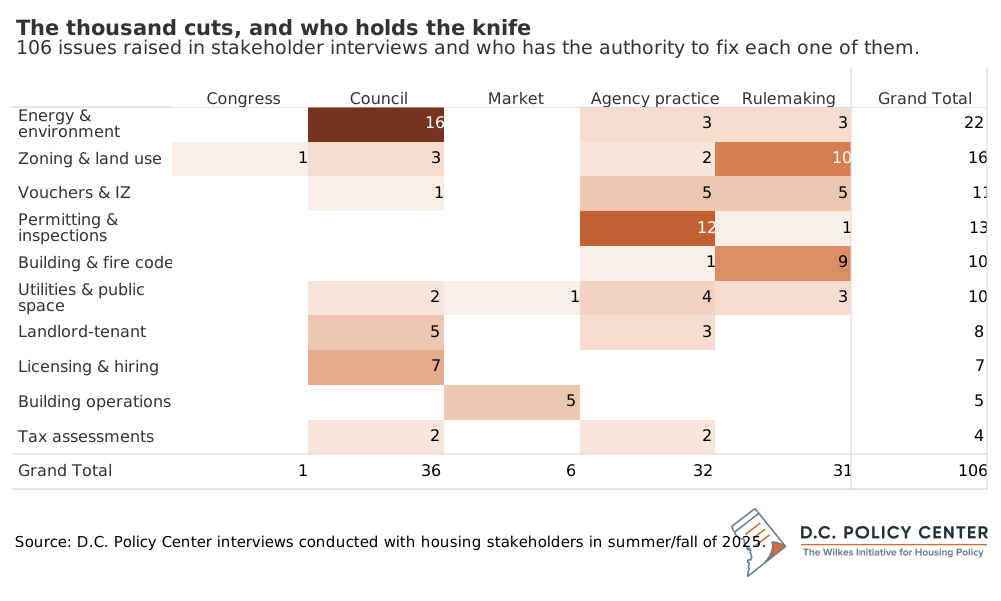
The problems are spread across the system, as is the authority to fix them. That is why a third-party review like the one B26-0822 establishes is needed. No existing agency can see, let alone address, the cumulative effects.
What our research shows about the cost of stacked rules
Our report documents individual cost drivers. What no one has measured is how they add up on a real project. A few examples show why that measurement is needed:
- Time is money. Each additional month of permitting delay raises total project costs by roughly 1 percent, about $4,400 per unit. Many projects still go through a dozen or more prescreen cycles, and up to nine rounds of sequential review from agencies operating independently.
- Appeals add more than a year to the Planned Unit Development (PUD) process. Since 2015, 89 appeals have sought to overturn zoning decisions. Only nine have succeeded, and the process adds an average of 450 days to timelines. Those appeals covered 17,219 units, including 2,823 affordable units.
- Local building code amendments exceed national standards. For example, the District requires 15 percent of units in buildings over ten units to meet Type A accessibility standards, compared with 5 percent for federally subsidized housing and 2 percent in the model International Code Council (ICC) code. Requirements for natural light, operable windows, and two staircases make smaller buildings and office conversions harder to deliver.
- Parking mandates are costly. Structured parking can add $50,000 or more per unit, and 96 percent of residential lots in the District carry parking minimums.
- Operating rules also drive up costs, though the bill does not explicitly cover them. BEPS penalties of $10 per square foot per year, rising utility charges that consume more than half of operating budgets in some affordable properties, and tax assessments that ignore affordability covenants all weaken the existing stock.
- Small projects are hit hardest. Accessory Dwelling Unit (ADU) construction in the District costs two to three times as much as elsewhere in the country. Only 2 percent of projects in the Residential Accessory Apartment Program made it through permitting and construction, and the program is now defunct.
Each item has a rationale. The problem is that the District has no way to see their combined effect, and so no way to judge which ones deliver benefits worth their cost.
Regulatory costs become subsidy costs
The central finding of our report is what we call the scarcity-subsidy cycle. Policy constrains supply and raises costs. Higher costs raise the subsidy needed to create each affordable unit. The city responds with larger and more complex subsidies, while the underlying constraints stay in place.
The District now spends more than $1 billion a year on housing, including $727 million in direct subsidies. Yet the full development cost of Housing Production Trust Fund (HPTF) projects is frequently two to four times that of market-rate development, and some projects exceed $1 million per unit. Low Income Housing Tax Credit (LIHTC) development costs can run double those of market-rate construction. Local Rent Supplement Program (LRSP) costs per unit tripled in real terms, from roughly $8,000 in 2016 to nearly $24,000 by 2023.
These are not separate problems. Every rule that adds cost or delay to a market-rate building adds it to a subsidized building too. The District pays that cost directly. That is why this bill is as much a fiscal accountability measure as a housing measure. Understanding regulatory costs is a precondition for stretching every subsidy dollar further.
The upside is also fiscal. Each new housing unit generates roughly $15,500 in combined annual tax revenue. Lowering the cost of production expands the tax base while reducing reliance on subsidies.
Why the comparison with Maryland and Virginia is important
The District competes directly with Arlington, Fairfax, and Loudoun in Virginia and Montgomery and Prince George’s in Maryland for housing investment, development, and residents. Investors price regulatory uncertainty, approval timelines, and future operating costs into the returns they require. When rules are uncertain or obligations hard to price, investors demand higher returns, and developers delay projects, scale them back, or build elsewhere. Residents, in turn, choose where to live based on housing cost, availability, quality, and access to jobs. Capital, development, and households all move across jurisdictional lines, so policies that make the District more expensive or less predictable push all three toward our neighbors.
A peer comparison tells the Council which of our costs are simply the cost of building in this region and which are self-imposed. Our goal should then be not only to match our regional peers but to outperform them.
Examples of similar studies can be informative.
Other jurisdictions have demonstrated that the cumulative costs of housing regulations can be systematically measured. In 2024, Portland, Oregon commissioned a study comparing the cost of developing the same 143-unit multifamily building in Portland, Seattle, Denver, and Sacramento, separating land, construction, financing, soft costs, and local fees. The study also examined the financial effects of Portland-specific policies across five development prototypes, from townhomes to high-rise buildings. Similarly, a 2018 study by UC Berkeley’s Terner Center for Housing Innovation used prototype developments to quantify fees across seven California cities, finding that multifamily development fees ranged from approximately $12,000 to $86,000 per unit. The researchers also found that fees were frequently imposed by different departments without coordination or a clear accounting of their cumulative effects. These studies demonstrate both the feasibility and value of measuring regulatory costs. The District should build on these approaches by examining not only direct fees, but also the cumulative effects of regulatory requirements, approval timelines, uncertainty, and ongoing operating obligations on housing feasibility and affordability (See Appendix for a full list).
Recommendations to strengthen the bill
Beyond a one-time review, our report recommended creating a standing Housing Feasibility Review Board with the clear charge of reducing costs to deliver compliant multifamily housing while maintaining safety and environmental outcomes. This Board should:
- Review housing codes, zoning, and housing-related regulations to assess their impact on project feasibility,
- Recommend repeal, simplification, or consolidation of outdated or duplicative requirements, and
- Apply a cost–benefit standard to new regulations, evaluating effects on housing production, preservation, and cost.
Other jurisdictions have institutionalized this kind of discipline. States and cities including Colorado,[3] Montana,[4] Arizona,[5] Washington State,[6] Massachusetts,[7] and New York City[8] have created task forces or statutory review processes to identify regulatory barriers and assess housing impacts. Without a comparable mechanism, the District continues to layer requirements that may make sense individually but together make multifamily and affordable housing harder to finance and operate.
We believe a standing feasibility review would improve predictability and reduce avoidable costs while preserving essential protections. Even modest reductions in regulatory burden could make more multifamily and mixed-income projects financially viable, make it easier to preserve and rehabilitate older buildings, and strengthen the District’s competitiveness for private investment.
We offer seven suggestions so that the third-party review produces findings the Council can act on:
- Measure the stack, not just the pieces. Require the reviewer to model prototype projects through the full regulatory sequence and report each requirement’s cost alongside the cumulative total. Prototypes should include a rowhouse with an ADU, a small walk-up of four to ten units, a mid-rise of 50 to 150 units, a large building of more than 150 units, an office-to-residential conversion, and a subsidized project financed with HPTF and LIHTC. Show the added effect of historic district review and the PUD process.
- Price time explicitly. Require reporting of median and range of timelines by approval step and by agency, including zoning relief, appeals, public space, utility, and historic review. Convert those timelines to carrying costs so delay can be compared with hard costs.
- Cover operating impacts, not only development impacts. Include Building Energy Performance Standards (BEPS) compliance, property tax treatment of income-restricted units, and the cost of landlord-tenant and voucher administration. The existing stock, including naturally occurring affordable housing, faces many of the heaviest burdens.
- Isolate local amendments. Identify where District rules exceed model codes or peer-jurisdiction rules, such as accessibility ratios, two-stair and sprinkler requirements, natural light rules, energy code paths, and the Green Construction Code. Estimate the cost of each difference.
- Translate costs into subsidy impact. Report how cumulative regulatory costs change the subsidy required per affordable unit, so the Council can see how many more units current HPTF and LRSP dollars could support under alternative rules.
- Make it recurring and public. A one-time study will age quickly. Require periodic updates, publication of the underlying data, and a short housing cost note for new rules affecting residential construction or operations. This could become the analytical backbone of the standing housing feasibility review board our report recommends.
- Ensure independence and data access. Require DOB, DDOT, DOEE, DC Water, the Historic Preservation Review Board, the Office of Zoning, and the Office of Tax and Revenue to share permit and review data with the reviewers. Time the final report to inform the Comprehensive Plan rewrite and the next budget cycle.
The bill pairs naturally with the other proposals in the Build Housing Package, including pre-approved plans, risk-based third-party review, and tax assessment alignment, all of which our report recommends. The cost review will show which of these and other reforms yield the most housing per dollar.
Closing
The District does not have to choose between growth and affordability. It must choose whether to keep a system that makes affordability expensive and scarce or build one that makes affordability attainable. That choice starts with knowing what our rules cost.
B26-0822 gives the Council the evidence to keep the rules that earn their cost, fix the ones that do not, and direct subsidy dollars where they do the most good. We thank Councilmembers White, Pinto, and Bonds for their leadership. We would be glad to share our data and methods with the Committee and the eventual reviewer.
Thank you. I am happy to answer questions.
Appendix
Several jurisdictions have undertaken systematic analyses of housing development costs, regulatory requirements, and government approval processes. These studies differ in scope: some quantify direct fees or model development feasibility, while others examine administrative processes and the cost of delay. Together, they establish methodological precedents for the review proposed under B26-0822.
The Portland and California studies are particularly relevant because they use standardized development prototypes to compare costs across jurisdictions. None, however, fully captures the combined effects of development regulations, administrative delays, and ongoing operating requirements. The District’s proposed review presents an opportunity to build on these approaches and develop a more comprehensive framework for evaluating regulatory costs.
Appendix Table. Selected studies and government initiatives measuring housing development costs and regulatory burdens
| Jurisdiction / study | Scope and methodology | Key findings | Relevance to B26-0822 |
| Portland, OR (2024) Residential Development Cost Study | Modeled the same 143-unit building in Portland, Seattle, Denver, and Sacramento. Separately tested local policy impacts across five housing prototypes. | Estimated development costs ranged from $407,000 to $489,000 per unit across the four cities. Identified differences in fees, soft costs, and approval processes, alongside market-driven costs. | Very high. Demonstrates cross-jurisdictional comparisons using standardized prototypes and evaluation of local policy costs. |
| Seven California cities (2018) It All Adds Up — Terner Center, UC Berkeley | Modeled development fees for prototype single-family and multifamily projects across seven cities. | Multifamily fees ranged from approximately $12,000 to $86,000 per unit. Documented substantial variation and limited coordination among departments imposing fees. | Very high. Demonstrates how to quantify the cumulative costs of government-imposed fees. |
| Seattle, WA (2015) Housing Affordability and Livability Agenda | Reviewed zoning, design review, historic preservation, and permitting practices affecting housing production. | Estimated that streamlining reviews and improving permitting predictability could shorten complex multifamily timelines by up to two months and save up to $4,000 per unit. | High. Demonstrates how approval time can be converted into measurable development costs. |
| Boston, MA (2024) Driving Down Construction Costs | Housing Innovation Lab analyzed city development data to identify cost drivers for market-rate and affordable housing. | Identified development approvals and disproportionately high soft costs, including architecture and financing expenses, as opportunities for cost reduction. | High. Demonstrates city-led evaluation of development costs and government processes. |
| New York City (2026) SPEED Report | Interagency review of environmental approvals, predevelopment, permitting, financing, and lease-up processes. | Proposed reforms projected to reduce development timelines by eight months for affordable housing projects generally and up to two years for certain projects requiring zoning changes. | High. Demonstrates comprehensive review of government processes, interagency coordination, and approval timelines. |
Note: Findings reflect estimates and analyses from the cited studies, not necessarily realized savings.
Endnotes
[1] U.S. Bureau of Census data compiled by the Office of the Chief Financial Officer, reported in Economic and Revenue Trends, August 2026.
[2] The single issue that is under the Congressional purview is the Height Act.
[3] In 2023, Colorado launched a statewide push to modernize local land use and regulatory practices to support housing growth. While a sweeping land use reform bill failed, the state continues to work through an Office of Housing Recovery to encourage localities to review and revise regulations that block housing. The state’s “Pro-Housing Local Government” designation incentivizes local governments to assess and streamline permitting timelines, reduce regulatory barriers, and modernize development rules.
[4] In 2023, Montana passed a suite of state-level bills that preempted or required modernization of outdated local regulations. HB 819 and HB 820 require cities to revise and modernize zoning codes and permit processes to prioritize housing supply. These laws included explicit directives for regulatory audits and updates tied to housing outcomes.
[5] Arizona’s Governor’s Housing Emergency Task Force (2023) recommended a formal regulatory audit process to review and revise local permitting rules, building codes, and zoning regulations that increase development costs. The task force emphasized prioritizing reforms that reduce costs for high-density and multifamily projects and recommended the creation of a transparent, metrics-driven review process to assess how cumulative regulations impact housing feasibility.
[6] Washington State’s Companion Regulatory Reform Bills to HB 1110 (2023)—which allowed for more types of housing across the state—require cities to conduct regulatory audits of zoning, design review, and building standards. Notably, some cities (e.g., Spokane and Tacoma) have already adopted “housing action plans” that include regulatory review processes focused on reducing barriers to multifamily housing.
[7] Massachusetts passed the Housing Choice Act in 2021 to ease zoning change thresholds to promote housing, but also to encourage localities to conduct comprehensive regulatory reviews of land use and permitting processes. The state’s Executive Office of Housing and Livable Communities now encourages municipalities to adopt “pro-housing” planning processes, including reviews of local ordinances and permitting rules that inhibit multifamily housing.
[8] New York City established the interagency Streamlining Procedures to Expedite Equitable Development (SPEED) Task Force, co-chaired by the Deputy Mayors for Housing and Planning and Operations, with representatives from key city agencies and coordination with state agencies and utilities. The Task Force is charged with identifying permitting and administrative barriers to housing production, recommending streamlining reforms (with an initial report due within 100 days), and overseeing ongoing implementation through 2030.